

Residential solar panels for Ottawa homes
KAJK designs, builds and installs rooftop solar for Ottawa homes: grid-tied with net metering through Hydro Ottawa or off-grid, solar-only or with battery backup. Every design starts with a cable and equipment power-loss calculation and a model of your roof, and you see the costs, equipment and plans before anything is ordered.
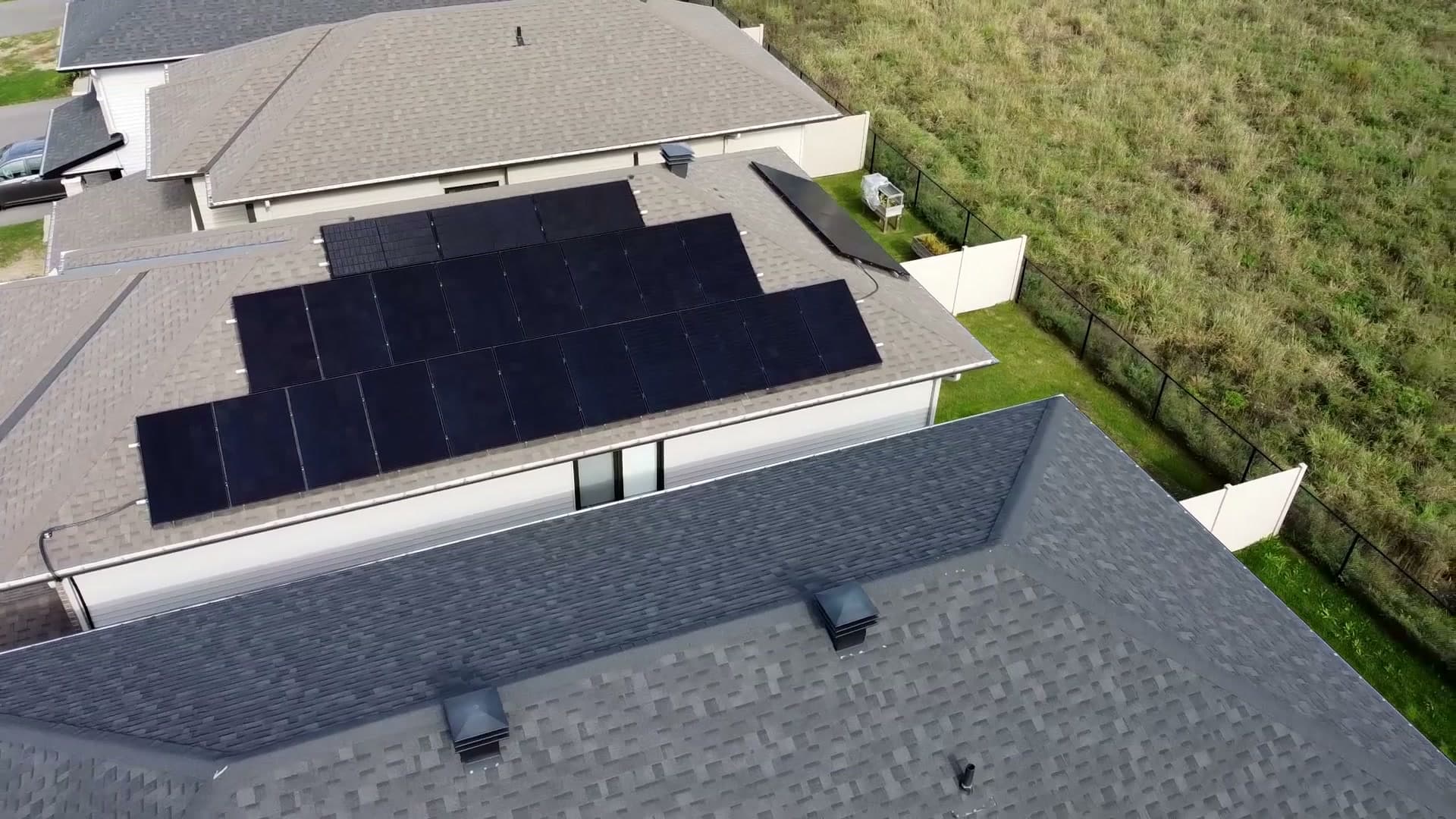
Professional solar panel installations in Ottawa
The addition of solar panels on your home's roof is a great way to reduce, or even eliminate, your consumption of local utility power. Whether you're looking for a solar-only or solar backup solution, we'll be happy to help. We will design and build a solar energy system that meets your consumption and install it with utmost care and precision.
What goes into a home solar design before you see a price
Residential solar panel arrays are not a one-size-fits-all type of system. They require thoughtful planning and precise calculations to meet your home's energy needs, roof dimensions, slope, orientation and your choice between grid-tied or off-grid. Here's what you can expect from us:
- Power-loss calculation
- We conduct a full cable and equipment power loss calculation, so wire runs and the inverter are sized before the panel count is fixed.
- Site modelling and simulation
- Site modelling and simulations to maximize future energy production: a model of your roof and the shade on it through the year.
- Concept design
- Costs, equipment selection, plans and warranties in one document.
- A walkthrough
- We explain the proposal, features and equipment so you decide with the numbers in front of you.
- Your configuration
- Grid-tied or off-grid, solar-only or solar backup with battery storage.
Is your roof ready? Age, direction, pitch and shade
Natural Resources Canada's Photovoltaic Ready Guidelines set the tests, and age comes first. NRCan recommends roofing with at least a 25-year service life to match the panels, so shingles near the end of theirs should be replaced before the array goes up.
Direction and pitch come next. A roof facing anywhere from east through south to west works, against NRCan's design target of 70% of the best output. The best annual angle is about 10° below the latitude: NRCan's data gives Ottawa 1,201 kWh a year per kW of panels facing south at about 30°, 1,200 at about 45° and 977 lying flat. Below 15°, panels shed snow poorly.
The panel area should stay clear of shade from the house, neighbours and mature trees all year, and the Ontario Energy Board warns that a new tree or building nearby can cut output for years. For the structure, NRCan budgets an added dead load of 0.17 kPa (3.5 psf) for panels mounted flush with the roof.
Permits and connection: the order things happen in Ottawa
Up to three bodies sign off on a grid-tied home system: the City of Ottawa, the Electrical Safety Authority (ESA) and Hydro Ottawa.
City of Ottawa building permit
Required for solar collectors with a face area of 5 m² or more on any building. A flush-mounted system on a low-rise home can be exempt if a professional engineer licensed in Ontario has assessed the roof as sound for the panels, wind and snow. The City targets a first review in five business days.
Hydro Ottawa service request
For systems of 12 kW AC or less, Hydro Ottawa sends a Service Layout within 15 days (up to 60 for complex projects) if the feeder has room. It is valid for 90 days and quotes Hydro Ottawa's share of the work.
ESA notification and inspection
The electrical work is filed with ESA before it starts and inspected before it is covered. Hydro Ottawa will not energize the system until ESA issues its Connection Authorization.
Connection and billing
Hydro Ottawa completes its work and exports start showing as bill credits. Its micro-generation charges are a $10 account set-up and $0.3616 a day.
Net metering or the Home Renovation Savings rebate: you choose one
The rebate's own page says participants who receive it cannot sign a net-metering agreement. Figures read 2026-10-01; terms change, and the assessment confirms what applies to your home. Every program is on our incentives page.
Net metering (O. Reg. 541/05)
- Exported power earns credits against the electricity charges on your bill
- Unused credits carry forward up to 12 months, then reset to $0
- Hydro Ottawa's simpler process covers 12 kW AC or less; the OEB raised that ceiling from 10 kW on 2026-05-01
- Batteries are allowed: stored solar still counts as your own generation
Home Renovation Savings rebate
- Solar: $1,000 per kW, up to 50% of costs, capped at $5,000
- Battery: $300 per kWh, up to 50%, capped at $5,000, only with new solar
- Load displacement only: no net metering at any time
- Written pre-approval before equipment is bought; new systems only
How much does it cost to install solar panels in Ottawa?
SolarQuotes.ca prices a typical 7.5 kW Ottawa home system at about $21,870 installed, before rebates (read 2026-10-01). It uses the Ontario average of $2.92 per watt for a roof-mounted system with Tier 1 panels and a string inverter, which puts 5 kW at $14,580 and 10 kW at $29,160.
Green Building Canada's Ontario guide, updated 2026-04-20, gives a wider range of $2.60 to $3.30 per watt installed.
Both are publishers' market figures; your quote comes from your design. It moves with the roof, the electrical panel, any battery and Hydro Ottawa's quote for its side of the connection. Some homes need panel work as well: Justin Davis wrote on Google that KAJK installed his solar system “along with some electrical upgrades.” The concept design itemizes all of it before you commit.
What is the 20% rule for solar panels?
No Ontario code, program or utility has a rule by that name. Online it most often means sizing an array to make about 20% more power than the home uses, as a buffer for cloudy stretches (House Digest, 2026-05-26). Some sites use it the other way round: cover about 80% of use (OUPES, 2025-11-07).
Net metering puts a ceiling on that habit. O. Reg. 541/05 requires the system to generate primarily for your own use, and credits still unused after 12 months reset to $0, so output beyond a year's use earns nothing. We size from your consumption and the losses we calculate.
The electrical code does have a real percentage rule. Rule 64-112 of the Canadian Electrical Code lets the breakers feeding a home's panel total up to 125% of its busbar rating (120% outside dwellings). In NRCan's worked example, a 100 A panel on a 100 A main breaker limits the solar breaker to 25 A at 240 V, about 4.8 kW.
Why are people getting rid of solar panels?
Four reasons recur in the sources, and a design can plan for each.
- The roof wears out first
- The IESO tells buyers of homes with microFIT systems to ask who pays to remove the panels when the roof needs work. NRCan's fix is roofing with 25 years left before the array goes on.
- The installer is gone
- Larry Fleece, on Google: “Kajk provided superior service to my solar system when other installers had gone out of business.” His system had squirrel damage.
- A contract ends or will not transfer
- microFIT opened on 2009-10-01, closed to applications on 2017-12-01 and pays over 20-year terms, so the earliest contracts end around 2030. Leases and power purchase agreements can carry fees if you cancel or move; the OEB tells buyers to check before signing.
- Output fades slowly
- NRCan puts degradation at about 0.6% a year over an expected life of 25 years or more, so it pays to track output year to year.
An Orléans install: 8.8 kW and 10 MWh a year
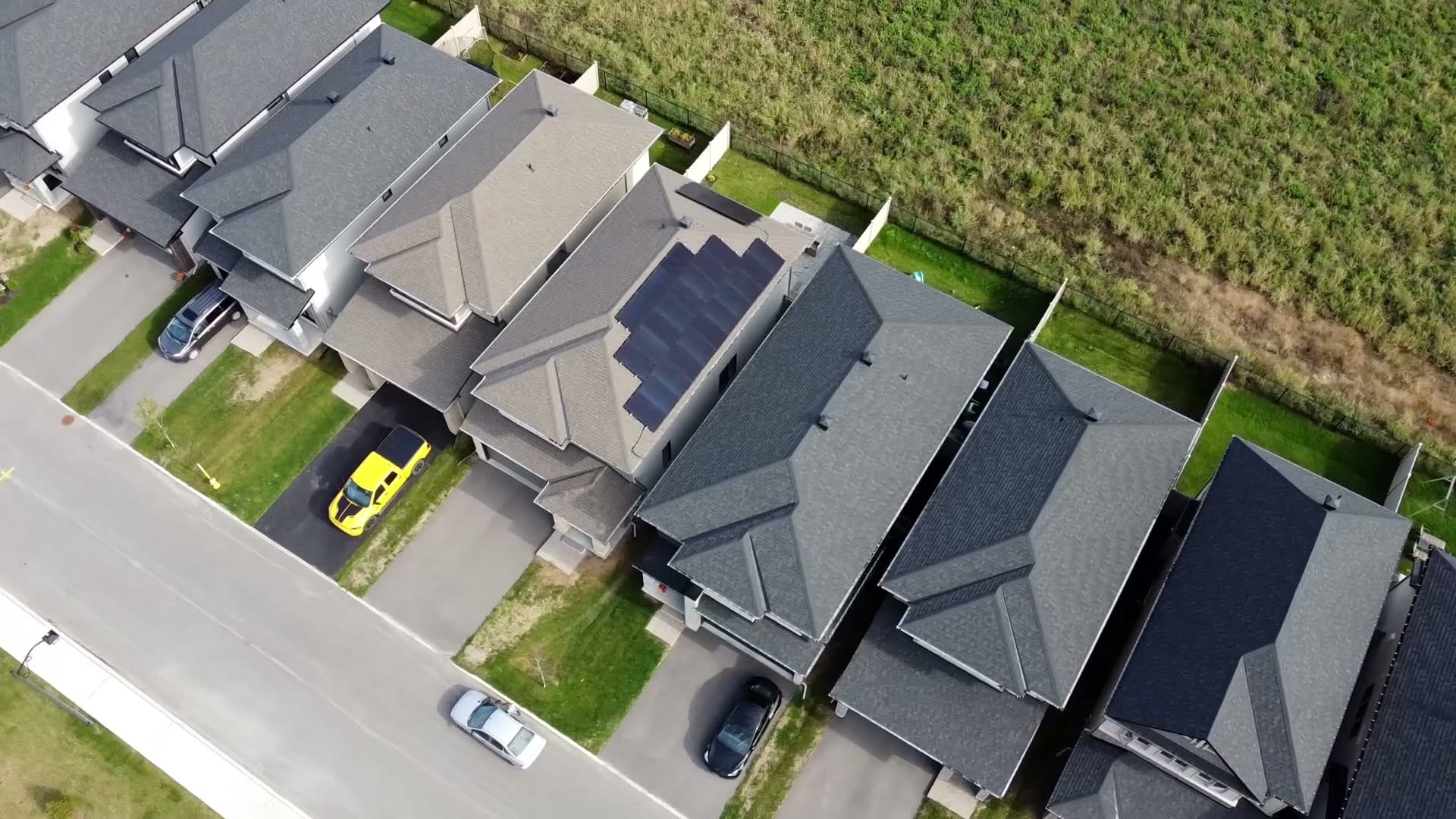
The video on our homepage, which covers solar panel installation in Ottawa, shows a net-metering install in Orléans. Its overlay reads 26 panels, 8.8 kW, 10 MWh a year. That is about 1,136 kWh per kW, inside the range NRCan publishes for Ottawa: 977 flat to 1,201 at the best fixed tilt.
Our process is simple
If you need solar energy solutions, we'll be there from conception to completion. We have the experience and accreditation to lead the way in all phases of your solar project. Here's what you can expect.
Consultation
From your initial assessment to project management, budgeting, scheduling and acquiring your permits, we handle all major aspects of your project.
Procurement
We acquire the best quality materials for your project at the lowest cost possible, giving you the best value for your dollar.
Design
We design your solar project to ensure that it meets your needs in the most affordable way possible. We do it all, including system designs to as-built drawings.
Construction
Our project manager leads all construction projects to ensure that installation, construction and maintenance projects go smoothly and efficiently.
Green incentives for your solar project
Take advantage of the various incentives and grants available for your solar energy retrofit project. Interest free loans, federal grants, and much more.
Programs change: the federal Greener Homes grant and interest-free loan closed in 2025. Ontario's rebates and the City of Ottawa loan are open, checked on 2026-10-01.
Ontario solar rebates open now“Khaled and his crew did an outstanding job with our solar install. Every step of the process was thoroughly explained and the installation was seamless”
Questions we get asked
How much does it cost to install solar panels in Ontario?
Green Building Canada's Ontario guide (updated 2026-04-20) puts installed home solar at $2.60 to $3.30 per watt, so 5 kW works out to about $13,000 to $16,500 before incentives. SolarQuotes.ca uses an Ontario average of $2.92 per watt for a roof mount. The Home Renovation Savings rebate takes up to $5,000 off if you give up net metering.
Can I add a battery to my solar panels later?
Yes under net metering: O. Reg. 541/05 counts stored solar as your own generation. The Home Renovation Savings battery rebate pays only when the battery goes in with a new solar system, and expansions are not eligible. On the rebate path, decide on the battery at the start, because that choice can be worth up to $5,000.
Do solar panels work through an Ottawa winter?
Yes, at a lower rate. NRCan's Ottawa data gives a south-facing array at about 45° roughly 79 kWh per kW in January against 125 in July. Snow matters too: NRCan notes that arrays at 15° or less shed it poorly, so steeper panels clear sooner after a storm.
What if my system is bigger than 12 kW?
Above 12 kW AC, Hydro Ottawa answers a Preliminary Consultation Information Request within 15 days, then runs a Connection Impact Assessment on drawings stamped by an Ontario professional engineer. For qualifying single-phase systems up to 30 kW, the simplified assessment costs $850 plus HST and takes up to 30 days.
Should solar go on the roof, the yard or a carport?
The roof is usually the cheapest place because the structure already exists. When the roof faces the wrong way, is shaded or needs replacing, ground-mount solar gives you the best tilt in the yard, and a solar carport adds a new roof over the driveway.
Sources for this page (19), last read 2026-10-01
- Solar collector systems (Do I need a building permit?)City of Ottawa, read 2026-10-01
- DER connection processHydro Ottawa, read 2026-10-01
- O. Reg. 541/05: Net MeteringGovernment of Ontario (e-Laws), read 2026-10-01
- Net meteringOntario Energy Board, read 2026-10-01
- Distribution System Code (DSC), amendment 42Ontario Energy Board, read 2026-10-01
- Notice of Amendments to the Distribution System Code (2025-12-18)Ontario Energy Board, read 2026-10-01
- Go solar and save up to $5,000 backHome Renovation Savings (IESO and Enbridge Gas), read 2026-10-01
- Solar and Battery Storage Pre-Installation Application Checklist (version October 2025)Home Renovation Savings (IESO and Enbridge Gas), read 2026-10-01
- Notifications and InspectionsElectrical Safety Authority, read 2026-10-01
- Photovoltaic potential and solar resource maps of Canada (municipal data file municip_potentiel-potential.csv)Natural Resources Canada, read 2026-10-01
- Photovoltaic Ready Guidelines, Version 1.0 (2018)Natural Resources Canada, CanmetENERGY, read 2026-10-01
- Guide to the Canadian Electrical Code, Part 1, 26th Edition: Section 64 (2026-06-08)Electrical Industry News Week, read 2026-10-01
- What Is The 20% Rule For Solar Panels? (Lindsay Donaldson, 2026-05-26)House Digest, read 2026-10-01
- What Is the 20% Rule for Solar Panels? (2025-11-07)OUPES, read 2026-10-01
- Solar Installers in Ottawa, ONSolarQuotes.ca, read 2026-10-01
- The Average Solar Panel Installation Cost in Ontario (2026), updated 2026-04-20Green Building Canada, read 2026-10-01
- microFIT OverviewIESO, read 2026-10-01
- microFIT: I am a Real Estate LawyerIESO, read 2026-10-01
- Kajk Constructors Inc reviewsBirdeye (mirror of Google reviews), read 2026-10-01
Contact Ottawa's solar energy experts
Ready to get started? Give us a call or send us a quick message for all your solar and green energy needs. The free assessment looks at your roof or site, your last year of electricity use and what you want the system to do, then comes back with a concept design, costs and the equipment we would use.
Monday to Friday, 9 a.m. to 5 p.m.
Saturday and Sunday: by appointment