

How net metering works in Ontario
Net metering lets an Ontario home, farm or business with solar panels send the power it does not use into the grid and take its value off later bills. Your local distribution company (LDC) values each exported kilowatt-hour at the rates you pay, under O. Reg. 541/05. Credits roll forward from bill to bill, are never paid out in cash, and reset to $0 only after a balance has been carried for 12 months in a row. Apply to your LDC before you buy anything.
How a net metering credit is worked out
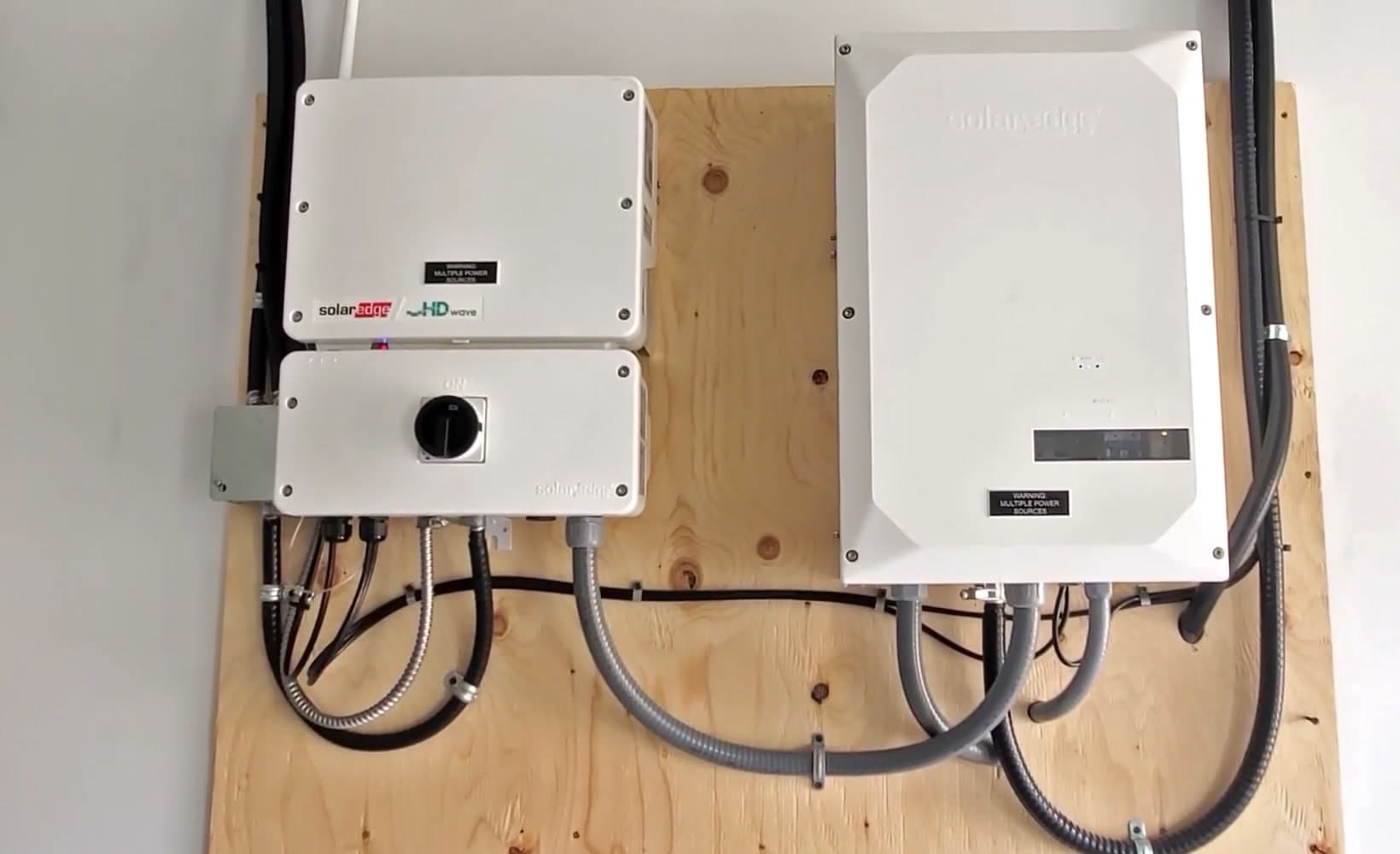
Each billing period your LDC reads two numbers: the kilowatt-hours you took from the grid and the kilowatt-hours your system sent into it. Section 8 of O. Reg. 541/05 values the exports on the same basis as the power you used, commodity included, and takes that value off every charge that depends on consumption. Charges that do not depend on consumption stay on the bill, whatever the panels made.
Hydro One's net metering page spells out the split. A credit can pay for the electricity itself, the distribution volume charge, transmission, variable rate riders, line losses and the wholesale market service rate. It cannot pay the monthly service charge, the smart meter entity charge, fixed rate riders or the standard supply service charge (read 2026-10-10).
The credit is a dollar amount. Hydro Ottawa's sample net metering bill builds it from credits on electricity, delivery and regulatory charges and shows the total as a Generation Credit Balance, which cannot be redeemed for cash or used to pay for other services. The regulation rules out paying it any other way (s. 8(15)).
The 12-month reset, and how sizing keeps every credit
Section 8(8) writes a balance down to $0 only when credits have been carried forward in every billing period of the previous 12 months. Hydro Ottawa's bill counts those periods as Cumulative Months of Generation and writes off the balance once the count reaches 12. A month in which your use draws the balance to zero restarts the count, and nothing is lost.
Ottawa's seasons decide which side of that line you land on. In Natural Resources Canada's data for Ottawa, a south-facing array at latitude tilt makes 722 kWh per kW from March to August and 479 from September to February, and November is the weakest month at 57 (NRCan, read 2026-10-10). Credit builds through spring and summer and is spent through the dark months. Size the array to a year of your use and winter spends it. Size it well past that and the surplus goes to the LDC's account every year (s. 8(13)).
Two other events clear a balance: the final bill when an account closes, as when you sell the house, and the end of the net metering agreement (s. 8(12)). You can cancel the agreement at any time on 90 days' written notice, but you cannot be net-metered again for 12 months after (s. 9).
Time-of-Use, Ultra-Low Overnight or Tiered: what each does to a credit
A net-metered home or small business picks a price plan like any other customer, and the LDC prices both the power you use and the credit you earn on that plan. Hydro One says so on its net metering page, and Hydro Ottawa's sample bill lists a separate credit for each Time-of-Use and Ultra-Low Overnight period. The prices below are the Ontario Energy Board's, set for 2025-11-01. The OEB sets new ones every November 1.
- Time-of-Use
- From May 1 to October 31, weekday on-peak runs 11 a.m. to 5 p.m. at 20.3¢ per kWh, the middle of the day, when panels produce most, so exports in those hours earn the top price. Power you buy back on weekday evenings after 7 p.m. and on weekends is off-peak at 9.8¢, less than half as much.
- Ultra-Low Overnight
- Every night from 11 p.m. to 7 a.m. costs 3.9¢, weekdays from 4 to 9 p.m. cost 39.1¢, and weekday daytime from 7 a.m. to 4 p.m. is mid-peak at 15.7¢, all year. On the commodity line, one kWh exported at mid-peak pays for four used overnight, which suits an EV charged after 11 p.m.
- Tiered
- One price at any hour: 12.0¢ for the first 600 kWh a month from May to October, or the first 1,000 from November to April, then 14.2¢. Credits are worked out on the same two tiers.
- One Ottawa owner's choice
- Hydro Ottawa published a customer's reasoning on 2024-02-20. He chose Ultra-Low Overnight for his 14.4 kW system because power made in the 4 to 9 p.m. window earns credit at the on-peak price, and his EV and heat pump make the overnight rate worth having. Your LDC's online account holds the hourly data that comparison needs: Hydro Ottawa's MyAccount keeps up to 24 months.
Who can net meter in Ontario
Sections 6 to 7.1 of the regulation set the tests, and they are short.
- Renewable, and mainly for your own use
- The power has to come solely from a renewable source, such as solar, and be generated primarily for your own use, with the surplus going to the grid. The regulation sets no kilowatt cap of its own. The size limit comes from your connection.
- Owned, leased or financed
- Since 2022-07-01 a leased, financed or power-purchase system qualifies too (s. 7.1). The other party has to disclose 16 things first, from the term and every cost you carry to who maintains the equipment and an estimate of its yearly output. The Ontario Energy Board adds that no one can sign you up for a power purchase agreement while they are at your home.
- Batteries paired with solar
- Electricity stored in a battery still counts as your own generation (s. 7(2)). Hydro Ottawa accepts a battery paired with a renewable system and turns down a battery on its own.
- On a retail contract
- A customer who buys power from a retailer can still net meter if the retailer confirms the contract allows it (s. 6). Hydro Ottawa asks for that confirmation before it starts on the project.
System size: the 12 kW line and feeder capacity
On 2026-05-01 the Ontario Energy Board raised the ceiling for micro-embedded generation in its Distribution System Code from 10 kW to 12 kW. The same amendments exempt residential customers from the commercial insurance requirement in the connection agreement (OEB notice of amendments, 2025-12-18). For most homes, 12 kW is the line that matters.
At 12 kW AC or less, Hydro Ottawa sends a Service Layout within 15 days of a service request, or up to 60 for complex projects, when the feeder has room, and the layout stays valid for 90 days. Above 12 kW the request starts with a Preliminary Consultation and moves to a Connection Impact Assessment on drawings stamped by an Ontario professional engineer. Hydro One splits its forms on the same line: Form C for 12 kW or less, Form B above it. Fees vary with system size.
Feeder capacity is the one limit a design cannot move. Under the Distribution System Code an LDC must accept net metering applications only until net-metered generation reaches 1% of its three-year average annual peak load. Six distributors were past that line in 2024, and the OEB has proposed raising it to 2% (report to the Minister, March 2026). Hydro Ottawa publishes a list of feeders that cannot host new generation of any size, and for a system of 12 kW or less it invites a service request to look for another way to connect.
How to apply for net metering, in order
From ontario.ca, the OEB, the City of Ottawa and the two utilities' process pages, read 2026-10-10.
Check the connection before you buy
Ontario's net metering page says not to buy or install equipment, or sign a contract, until your electricity distributor approves the project. The IESO's utility finder tells you which LDC serves your address.
Choose net metering or the rebate
Decide before the design is final. A system rebated by Home Renovation Savings is for load displacement only and can never be net-metered. Every program and its status is on our Ontario solar rebate page.
Apply to your LDC
At 12 kW AC or less it is a service request (Hydro Ottawa) or Form C (Hydro One), marked for net metering. Larger systems take the consultation and impact assessment route above.
Permit and electrical inspection
In Ottawa a building permit covers panels with a face area of 5 m² or more on a building, designed and reviewed on site by an Ontario professional engineer, and the City targets a first review within five business days for a house. A flush-mounted system on a low-rise home can be exempt once an engineer has assessed the roof. As the installer, we file the notification with the Electrical Safety Authority (ESA), and the LDC energizes nothing until ESA issues its Connection Authorization.
Sign the agreement
You sign a net metering agreement with the LDC, it finishes its share of the work, and exports start showing as credits on your bill.
Is net metering worth it in Ontario?
For most homes with a usable roof, yes, by The Atmospheric Fund's analysis. The regional climate agency estimated on 2026-07-10 that a 10 kW net-metered system pays back in roughly half the time of a comparable system without net metering, rebate included. It found the rebate can come out ahead for a home with little roof space that wants a battery.
The rebate is the alternative, and Ontario makes you pick one per system. Home Renovation Savings pays $1,000 per kW of panels up to $5,000 and $300 per kWh of battery up to $5,000, each capped at half the eligible cost, with HST left out of that cost. The money is only for a first rooftop system used for load displacement, and the program names ground-mounted solar as ineligible (Solar and Storage Program Stream Requirements, version October 2025, read 2026-10-10).
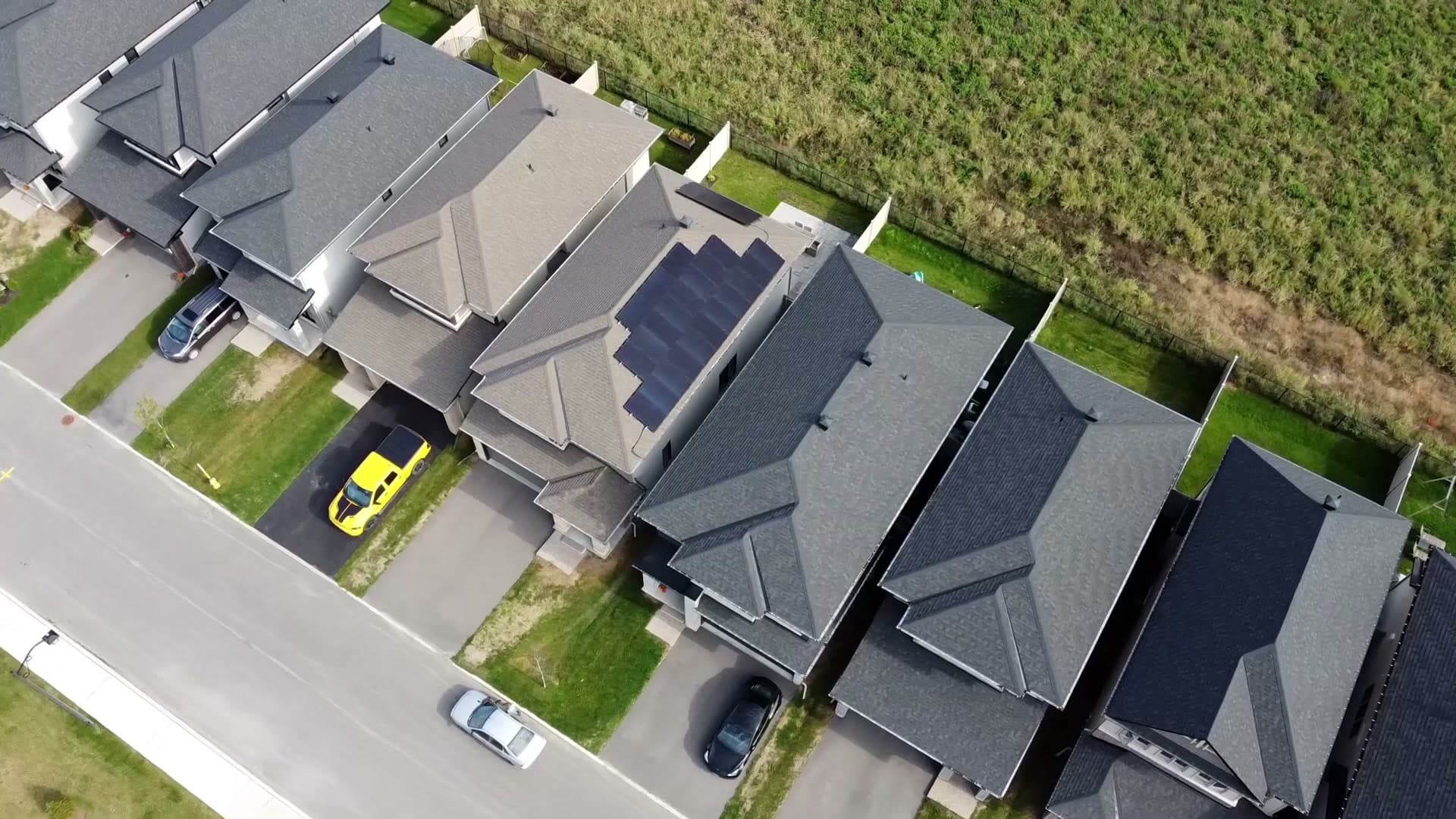
Net metering pays nothing upfront and credits every exported kWh for as long as the agreement runs. Our Orléans install was built for it: 26 panels and 10 MWh a year, by its video overlay.
What are the downsides of net metering?
Four limits shape a net-metered design, and each has a known answer.
- Credits are not cash
- Output beyond a year's use earns nothing once the 12-month count runs out. The answer is sizing: an array matched to your bills spends its credit.
- Fixed charges stay
- Credits cover consumption-based charges only, so the monthly service charge and the other fixed charges are on every bill (Hydro One).
- No upfront incentive
- A net-metered system gives up Home Renovation Savings for a home. For a business it gives up Save on Energy's Retrofit incentive, whose participant agreement rules out net metering for the life of the system (Retrofit Program FAQ, read 2026-10-10).
- Approval comes first
- Feeder capacity is confirmed before any equipment is bought, so the LDC's answer sets the start date.
Is net metering ending in Ontario?
Not as of 2026-10-10. The last amendment to O. Reg. 541/05, O. Reg. 386/22, took effect on 2022-07-01, and e-Laws shows that version as current to 2026-10-07. The change so far is a recommendation. In its March 2026 report to the Minister of Energy and Mines, released 2026-09-02, the Ontario Energy Board recommended moving from net metering to net billing, which would pay for exported power through a tariff set by the time and place it enters the grid.
The same report says a transition should consider a legacy provision for existing net-metered customers, to account for the payback of systems already installed, with adequate notice of any change. It put net metering's adoption rate below one percent. The recommendation is addressed to the Ministry, which sets the net metering rules.
Is it better to have more solar panels or more batteries?
On net metering, panels come first. The grid already holds your summer surplus as a credit for up to 12 months, so a battery is not needed to keep that value. A battery is worth adding for backup: the Canadian Renewable Energy Association notes that panels will not power a building during an outage unless storage is attached. It also lets the house use its own solar in the evening, which counts most in Ultra-Low Overnight's 39.1¢ hours.
Net metering accepts a battery paired with solar. The rebate is narrower: Home Renovation Savings pays for a battery only when it is paired with a new solar system sized for it. Sizing and backup circuits are on our solar battery storage page.
Net metering for businesses, farms and ground mounts
The same regulation covers a business, a farm or an institution, and the same 12 kW line decides the connection route. One difference shows on a demand-billed account: credits are worked out on kWh, so they do not offset charges billed on peak kW (Hydro One; O. Reg. 541/05, s. 8).
Net metering has no mounting rule, so a ground mount or a solar carport can be net-metered where the incentive programs draw lines. Home Renovation Savings excludes ground-mounted solar, and Save on Energy's Retrofit incentive covers only rooftops and parking canopies. Sharing one array's credits across several accounts, called community net metering, exists only as a demonstration project, and the OEB has recommended opening it up. Larger systems are on our commercial solar page.
Bring a year of bills to the free assessment
Net metering rewards a system sized to your use, so the assessment starts from your address and 12 months of electricity data. We settle net metering or the rebate before the design is final and take care of the permits in the order above. For the price side, read what solar panels cost in Ottawa, or start with our solar panels in Ottawa page. Call (613) 869-8254.
Our process is simple
If you need solar energy solutions, we'll be there from conception to completion. We have the experience and accreditation to lead the way in all phases of your solar project. Here's what you can expect.
Consultation
From your initial assessment to project management, budgeting, scheduling and acquiring your permits, we handle all major aspects of your project.
Design
We design your solar project to ensure that it meets your needs in the most affordable way possible. We do it all, including system designs to as-built drawings.
Procurement
We acquire the best quality materials for your project at the lowest cost possible, giving you the best value for your dollar.
Construction
Our project manager leads all construction projects to ensure that installation, construction and maintenance projects go smoothly and efficiently.
Warranty, operation & maintenance
Once your system is running, we stay with it: warranty support, operation, maintenance and repairs, including on systems other installers put in.
Questions we get asked
What is the 20% rule for solar?
It is a sizing rule of thumb from equipment sellers' guides, not an Ontario rule: build the array about 20% bigger than your use. Under net metering it works against you, because credit carried for 12 straight months is written off. Size to your last 12 months of bills, plus any load you know is coming, such as an EV.
Why are people getting rid of their solar panels?
We found no Ontario data on owners removing working panels in numbers. The cases we can trace are contracts and roofs. The IESO's microFIT program took applications from 2009-10-01 to 2017-12-01 and paid a fixed price over a 20-year term, so its contracts run out over the coming years, and the IESO now points anyone interested in small-scale generation to net metering through their LDC. A reroof takes the panels off and puts them back.
What happens to my net metering credits if I sell my house?
They go to $0. The regulation clears any remaining balance on the final bill when an account closes (s. 8(12)), and credits can never be paid out (s. 8(15)).
Can I net meter a battery without solar panels?
No. Net metering needs renewable generation. Hydro Ottawa counts a battery as a source while it discharges, so a battery paired with solar joins the program, but a battery on its own does not qualify.
Will my utility pay me for the power I export?
Not in cash. Exports become a credit against consumption-based charges on later bills, carried for up to 12 months (O. Reg. 541/05, s. 8). Being paid for every kWh is a different arrangement, which Hydro Ottawa calls stand-alone generation: it needs a dedicated electrical service and a generator licence from the OEB.
Sources for this page (20), last read 2026-10-10
- O. Reg. 541/05: Net Metering (consolidated from 2022-07-01, e-Laws currency date 2026-10-07)Government of Ontario (e-Laws), read 2026-10-10
- Net meteringOntario Energy Board, read 2026-10-10
- Save on your energy bill with net metering (updated 2025-10-10)Government of Ontario (ontario.ca), read 2026-10-10
- Net MeteringHydro One, read 2026-10-10
- Types of DERsHydro Ottawa, read 2026-10-10
- DER connection process and application formsHydro Ottawa, read 2026-10-10
- Net metering bill sampleHydro Ottawa, read 2026-10-10
- A homeowner harnesses the power of the sun (blog, 2024-02-20)Hydro Ottawa, read 2026-10-10
- Track your usageHydro Ottawa, read 2026-10-10
- Electricity rates (prices set for 2025-11-01)Ontario Energy Board, read 2026-10-10
- Notice of Amendments to the Distribution System Code, EB-2019-0207 (2025-12-18)Ontario Energy Board, read 2026-10-10
- Report to the Minister of Energy and Mines: Valuation of Distributed Energy Resources (March 2026; released 2026-09-02)Ontario Energy Board, read 2026-10-10
- Go solar and save up to $5,000 backHome Renovation Savings (Enbridge Gas and IESO), read 2026-10-10
- Solar and Storage Program Stream Requirements, version October 2025Home Renovation Savings (Enbridge Gas and IESO), read 2026-10-10
- Retrofit Program FAQs (Solar PV DER)Save on Energy (IESO), read 2026-10-10
- Solar collector systems (Do I need a building permit?), page dated 2026-07-29City of Ottawa, read 2026-10-10
- Photovoltaic potential and solar resource maps of Canada: municipality database (kWh/kWp)Natural Resources Canada, read 2026-10-10
- How Solar WorksCanadian Renewable Energy Association, read 2026-10-10
- Ontario's solar rebate has a hidden catch (2026-07-10)The Atmospheric Fund, read 2026-10-10
- microFIT OverviewIESO, read 2026-10-10
Contact Ottawa's solar energy experts
Ready to get started? Give us a call or send us a quick message for all your solar and green energy needs. The free assessment looks at your roof or site, your last year of electricity use and what you want the system to do, then comes back with a concept design, costs and the equipment we would use.
Monday to Friday, 9 a.m. to 5 p.m.
Saturday and Sunday: by appointment