

Commercial and industrial solar in Ottawa
KAJK Constructors designs, permits, builds, tests and maintains solar systems for Ottawa businesses and industrial sites, as a solar energy retrofit on an existing building or as solar with backup storage. A commercial array lowers what you pay for metered power and the carbon behind it. The incentive you pick shapes the design, so it is settled first.
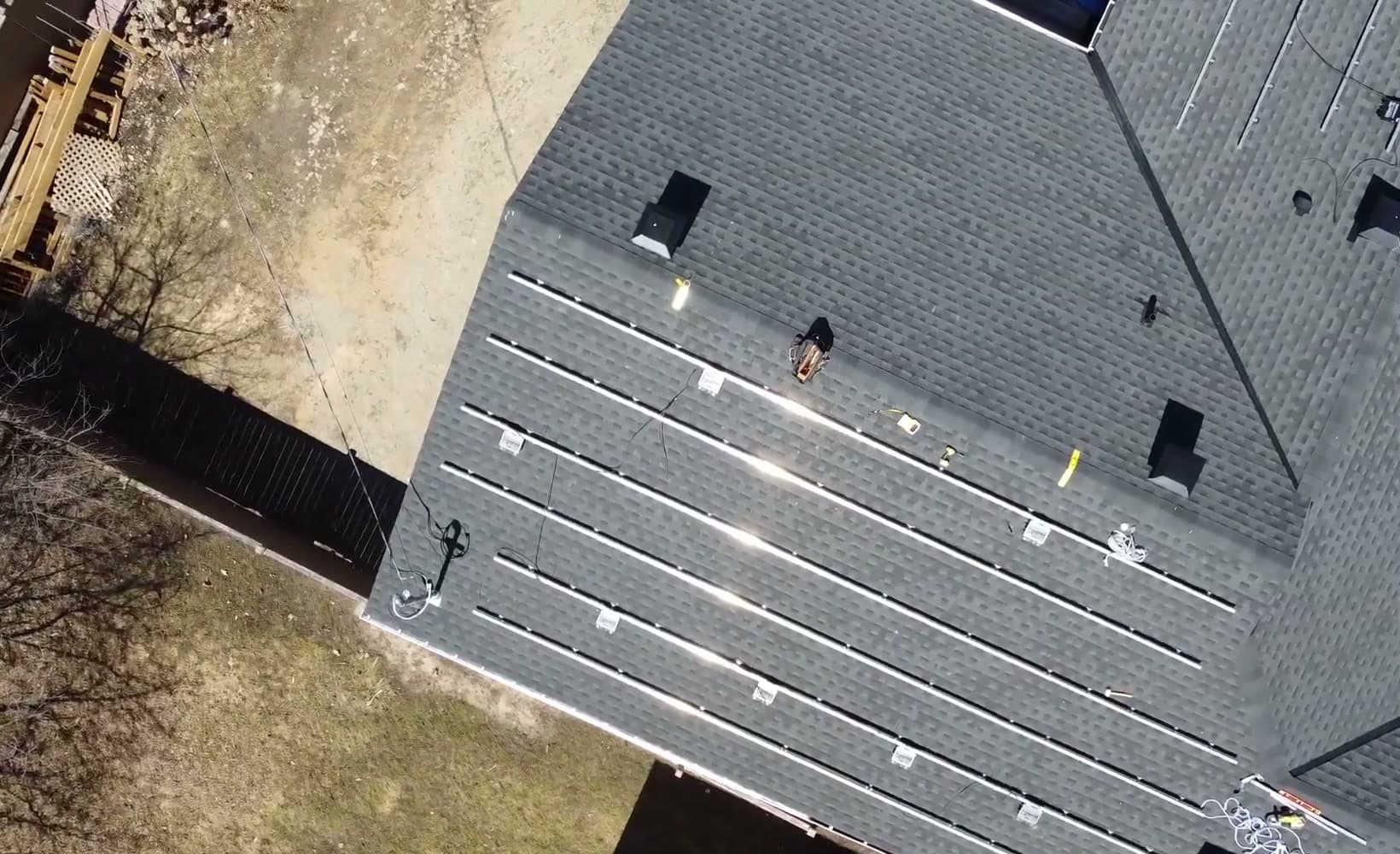
Complete commercial and industrial solar solutions
Solar energy has proven to be a great long-term solution to lower utility costs, and it also contributes to carbon neutrality. If your commercial or industrial location is in need of a solar energy retrofit or solar backup systems, get in touch with us today. KAJK Constructors is your trusted partner in all things solar, from the design, permit acquisition, construction, testing and maintenance of your commercial solar systems.
Enhance your brand's public image and reduce costs
Going forward with a commercial green retrofit is a great way to enhance your brand's public image through sustainable means. Let your audience and clients know that you support the switch to green energy in efforts to reduce your carbon footprint. Solar retrofit benefits also include:
- Reduces your energy costs
- Reduces your carbon footprint
- Attracts public attention
What an Ottawa commercial solar project has to clear
Every commercial array in Ottawa answers to three authorities: the City, Hydro Ottawa and ESA. Permit acquisition is part of our scope, and the order matters:
Incentive pre-approval, if you want one
Save on Energy requires the Retrofit application before any binding commitment, so no purchase order for the solar system goes out until it is in. Pre-approval then gives you 24 months to finish.
Hydro Ottawa consultation and impact assessment
Above 12 kW AC, Hydro Ottawa starts with a Preliminary Consultation Information Request, answered within 15 days, then a Connection Impact Assessment stamped by an Ontario professional engineer. That takes 60 days or more and expires after six months. Fees read 2026-10-01: $960.50 for the simplified version (inverter-based, 50 kW or less, no batteries), $1,130 for a generator up to 500 kW.
City of Ottawa building permit
Required for any solar array with 5 m² or more of panel area on a building. An Ontario professional engineer designs the system and reviews it on site, covering panel weight, wind and snow loads, ballast and anchors. First review for a commercial building takes 10 business days.
ESA and connection
The electrical work is filed with ESA, and Hydro Ottawa connects only after ESA's Connection Authorization. Commissioning follows Hydro Ottawa's DER commissioning guide.
Testing and maintenance
We test the system at commissioning, and maintenance stays part of our scope after it.
Commercial solar incentives in Ontario for 2026
These are the three programs an Ottawa commercial project can draw on. We read each on its own page on 2026-10-01. Terms change, and the assessment confirms what applies to your building.
- Save on Energy Retrofit program, solar PV
- $1,000 per kW-DC up to 10 kW, and $770 per kW-AC above 10 kW up to 1 MW-AC, cut from $860 in an update dated 2026-05-29. Capped at 1,000 kW-AC and 50% of eligible costs. Rooftops and parking canopies only, and the system must run as load displacement for its whole life, so no net metering.
- Clean Technology Investment Tax Credit
- A refundable credit of up to 30% of the capital cost of equipment that generates electricity from solar, for taxable Canadian corporations and real estate investment trusts, on property in use from March 28, 2023 to the end of 2033, then 15% in 2034. The rate drops 10 points if the project does not meet the prevailing-wage and apprenticeship requirements.
- Capital cost allowance, Class 43.1
- Solar generating equipment is written off at 30% a year on a declining balance (CRA Income Tax Folio S3-F8-C2). Bill C-15, which received Royal Assent on 2026-03-26, restores a 100% first-year deduction for Class 43.1 clean energy generation equipment acquired from 2025-01-01 and in use before 2030.
Is there an Ottawa commercial solar grant?
Not from the City. The “Ottawa commercial solar grant” in search results traces back to Save on Energy. On 2024-01-08 its Retrofit program began offering a solar incentive for businesses in Ottawa only, and on 2025-01-08 that incentive opened to the whole province. It is the Retrofit incentive above. The City's own Better Buildings Ottawa financing page listed no City grant for commercial solar when we read it on 2026-10-01. Our energy incentives page tracks the programs as they change.
Net metering or load displacement: decide before the design
Ontario lets a business run solar two ways, and the choice changes the array size and the incentive.
We found no 2025 or 2026 change to the net metering rules. Ontario's e-Laws shows O. Reg. 541/05 last amended by O. Reg. 386/22, consolidated to 2026-09-28.
Net metering (O. Reg. 541/05)
- Generation must be primarily for your own use
- Exports are valued at your per-kWh rates, with no value for demand; credits expire after 12 months
- No kilowatt cap in the regulation; Hydro Ottawa's grid capacity, including feeders it cannot host on, sets the real limit
- Since July 1, 2022, a third party may own the system on your site
Load displacement (Save on Energy Retrofit)
- Everything the array makes is used on site
- Earns the Retrofit incentive, up to 50% of eligible costs
- Locked in for the life of the system
- Rooftop and parking canopy arrays only
How much is a commercial solar system?
Green Building Canada's commercial cost guide, published 2026-01-13, puts commercial installations in Canada at $1.90 to $2.80 per watt before incentives in 2025. That figure includes panels, inverters, racking, labour, permits and electrical work. On its numbers, 50 kW runs $95,000 to $140,000, 100 kW $190,000 to $280,000, and 500 kW $950,000 to $1.4 million.
Those are national market ranges, not our prices. Roof reinforcement and grid upgrades sit outside them, which is why the engineer's structural review and Hydro Ottawa's impact assessment are what turn a range into a quote.
Rooftop, parking canopy or ground mount
Start with the roof's remaining life. The Canadian Roofing Contractors Association's Bulletin 57 says solar belongs only on roofs in good condition, with ponding water and edge or flashing problems fixed first, because at re-roofing time the whole array may have to come off and go back on.
If the roof is not ready, the array can go elsewhere. A solar carport over your parking qualifies for the same Retrofit incentive as a rooftop. A ground mount does not, but it frees the system from the roof entirely, and the tax credit does not depend on where the panels sit.
Solar backup adds batteries. Ontario requires the storage to be certified to ANSI/CAN/UL 9540 or field-evaluated (ESA Bulletin 64-7-2), and Hydro Ottawa's 30-day simplified impact assessment excludes any project with storage, so plan for the full one.
Lower costs, lower carbon, and a commitment people can see
Save on Energy lists the gains as lower metered energy consumption, clean generation year-round and fewer greenhouse gas emissions. On a building that buys most of its power during weekday daylight, a rooftop array produces when the building needs it.
It is also a sustainability step customers and tenants can see from the parking lot. A solar canopy over the spaces, with workplace EV charging underneath, shows it to everyone who parks there.
Our process is simple
If you need solar energy solutions, we'll be there from conception to completion. We have the experience and accreditation to lead the way in all phases of your solar project. Here's what you can expect.
Consultation
From your initial assessment to project management, budgeting, scheduling and acquiring your permits, we handle all major aspects of your project.
Procurement
We acquire the best quality materials for your project at the lowest cost possible, giving you the best value for your dollar.
Design
We design your solar project to ensure that it meets your needs in the most affordable way possible. We do it all, including system designs to as-built drawings.
Construction
Our project manager leads all construction projects to ensure that installation, construction and maintenance projects go smoothly and efficiently.
Green incentives for your solar project
Take advantage of the various incentives and grants available for your solar energy retrofit project. Interest free loans, federal grants, and much more.
Programs change: the federal Greener Homes grant and interest-free loan closed in 2025. Ontario's rebates and the City of Ottawa loan are open, checked on 2026-10-01.
Ontario solar rebates open now“I've had an exceptional experience with Khaled and his team at Kajk. The installation went smooth, everything was done on time and with high quality.”
Questions we get asked
What is the average cost of a commercial solar panel system?
Per watt installed, Green Building Canada's guide (2026-01-13) puts commercial solar in Canada at $1.90 to $2.80 before incentives for 2025, covering panels, inverters, racking, labour, permits and electrical work. Bigger systems sit lower in that range. For an Ontario corporation, the 30% Clean Technology tax credit and the Save on Energy Retrofit incentive can cut the net cost, each under its own rules.
What is the 20% rule for solar?
In Ontario's electrical code, the closest rule is 64-112. In a building other than a home, the breakers feeding a panel, utility and solar together, may add up to 120% of the panel's busbar rating; homes get 125%. Beyond that, the inverter connects on the supply side of the main disconnect (ESA Bulletin 64-1-4, May 2024). You may also see it used for sizing an array about 20% above your usage, which is a rule of thumb, not a code rule.
Why are people getting rid of their solar panels?
The two reasons that come up are both avoidable at design time. A roof that needs replacing under an array means taking the whole system down and putting it back (CRCA Bulletin 57), so the roof's remaining life is checked before the design. The other is a lease or power purchase agreement the owner regrets; the OEB tells customers to ask what cancelling costs and what happens if they move, before signing.
Can a business use net metering in Ontario?
Yes. O. Reg. 541/05 covers any customer generating renewable electricity primarily for its own use, with no size cap in the regulation. Exports are valued at the rates you pay per kWh, with no value for demand, and credits expire after 12 months. Hydro Ottawa's grid capacity and approval decide what you can connect. Net metering cannot be combined with the Save on Energy Retrofit incentive.
Do ground-mounted commercial arrays qualify for Save on Energy incentives?
No. Save on Energy's Retrofit FAQ (read 2026-10-01) limits the solar PV incentive to rooftop and parking canopy installations, and an update dated 2026-05-29 removed wall-mounted systems as well. A ground mount can still use the Clean Technology tax credit and Class 43.1 capital cost allowance, since those follow the equipment, not the mounting.
Sources for this page (17), last read 2026-10-01
- Solar Photovoltaic (PV) incentives, Retrofit programSave on Energy (IESO), read 2026-10-01
- Retrofit program FAQs (Solar PV / DER)Save on Energy (IESO), read 2026-10-01
- News and updatesSave on Energy (IESO), read 2026-10-01
- Clean Technology Investment Tax Credit (modified 2026-07-14)Canada Revenue Agency, read 2026-10-01
- Clean Technology ITC (modified 2026-05-01)Canada Revenue Agency, read 2026-10-01
- Income Tax Folio S3-F8-C2, Tax Incentives for Clean Energy EquipmentCanada Revenue Agency, read 2026-10-01
- Canada substantively enacts capital cost allowance and other business income tax measures in Bill C-15 (2026-03-03)EY Canada, read 2026-10-01
- Tax Alert 2026 No. 22: 2025 budget implementation bill no. 1 receives Royal Assent (2026-03-27)EY Canada, read 2026-10-01
- DER connection processHydro Ottawa, read 2026-10-01
- Solar collector systems: do I need a building permit? (page dated 2026-07-29)City of Ottawa, read 2026-10-01
- Financing and incentivesCity of Ottawa (Better Buildings Ottawa), read 2026-10-01
- O. Reg. 541/05: Net Metering (consolidated July 1, 2022 to e-Laws currency date 2026-09-28; last amendment O. Reg. 386/22)Government of Ontario (e-Laws), read 2026-10-01
- Net meteringOntario Energy Board, read 2026-10-01
- What Commercial Solar Panels Cost in Canada in 2026 (published 2026-01-13)Green Building Canada, read 2026-10-01
- Bulletin 64-1-4: Utility-interactive inverters (issued May 2024)Electrical Safety Authority (ESA), read 2026-10-01
- Bulletin 64-7-2: Installation and Approval of Energy Storage Systems (October 2023)Electrical Safety Authority (ESA), read 2026-10-01
- Bulletin 57: Photovoltaics in Roofing (November 2010)Canadian Roofing Contractors Association, read 2026-10-01
Contact Ottawa's solar energy experts
Ready to get started? Give us a call or send us a quick message for all your solar and green energy needs. The free assessment looks at your roof or site, your last year of electricity use and what you want the system to do, then comes back with a concept design, costs and the equipment we would use.
Monday to Friday, 9 a.m. to 5 p.m.
Saturday and Sunday: by appointment