

Solar panels on your roof: is it ready?
For most homes, the roof is the best place for solar panels: Natural Resources Canada calls roof mounting the most cost-effective choice in most residential installs. The best fit is a new roof or one 10 years old or under, facing east through south to west. We check yours at a free assessment for solar panels in Ottawa.
On this page
- What makes a roof ready for solar panels
- Why the roof is the usual place for home solar panels
- Roof age: new, or 10 years old or under
- Which roofs KAJK puts solar panels on
- How your roof's pitch and direction affect output
- How an Ottawa roof carries solar panels and snow
- How the free assessment checks your roof
- Put solar panels on your roof with KAJK
- Questions
What makes a roof ready for solar panels
Five things decide it, and the free assessment looks at each one on your roof:
- Age
- A new roof is the best fit, and the next best is one 10 years old or under. The panels cover the membrane under them and help it last longer.
- Structure
- The framing carries the panels, the wind and the snow. A professional engineer licensed in Ontario confirms it before the array goes up.
- Direction
- Any face from east through south to west. South collects the most, and NRCan's guidelines accept east to west against a design target of at least 70% of the best output.
- Pitch
- NRCan recommends 4/12 to 18/12, which is 15° to 56°. A flat or low-slope roof takes tilted racking.
- Space and shade
- A clear area away from vents, chimneys and skylights, out of shade from trees and neighbouring buildings through the year. NRCan's best-practice layout keeps the panels 18 to 36 inches (45.7 to 91.4 cm) below the ridge, with clear pathways from ridge to eave for firefighters.
The direction and shade figures for an Ottawa home are in our roof check for home solar.
Why the roof is the usual place for home solar panels
The structure is already there. NRCan's Photovoltaic Ready Guidelines call roof-mounted equipment the most cost-effective way to install a solar PV system in most residential applications, so a home system starts with the roof.
The provincial rebate points the same way. Ontario's Home Renovation Savings program pays $1,000 per kW of new rooftop solar panels, up to $5,000 and up to half of total costs (program terms, November 2026). A system that takes the rebate runs as load displacement and does not join net metering, so you choose one or the other. Both routes are in our solar rebates and incentives guide.
Where a roof faces north, sits in shade or is due for replacement, the panels can go elsewhere. Ground-mount solar panels take the best angle in the yard, and a solar carport adds a new roof over the driveway.
Roof age: new, or 10 years old or under
Roof age is the first thing we look at, because the panels and the roof under them share the decades ahead. A new roof is the best fit. The next best is a roof 10 years old or under: the panels cover the roof membrane and help prolong its life.
If the roof needs work later, the array comes off and goes back on once it is done. A one-time removal and reinstall can be written into your quote, so the plan for the roof's next replacement is settled before the first panel goes up. The same removal for roof work is part of our solar panel repair and maintenance service for systems already in place.
The short answer to what if I need to replace my roof after panels are installed is in our residential questions.
Which roofs KAJK puts solar panels on
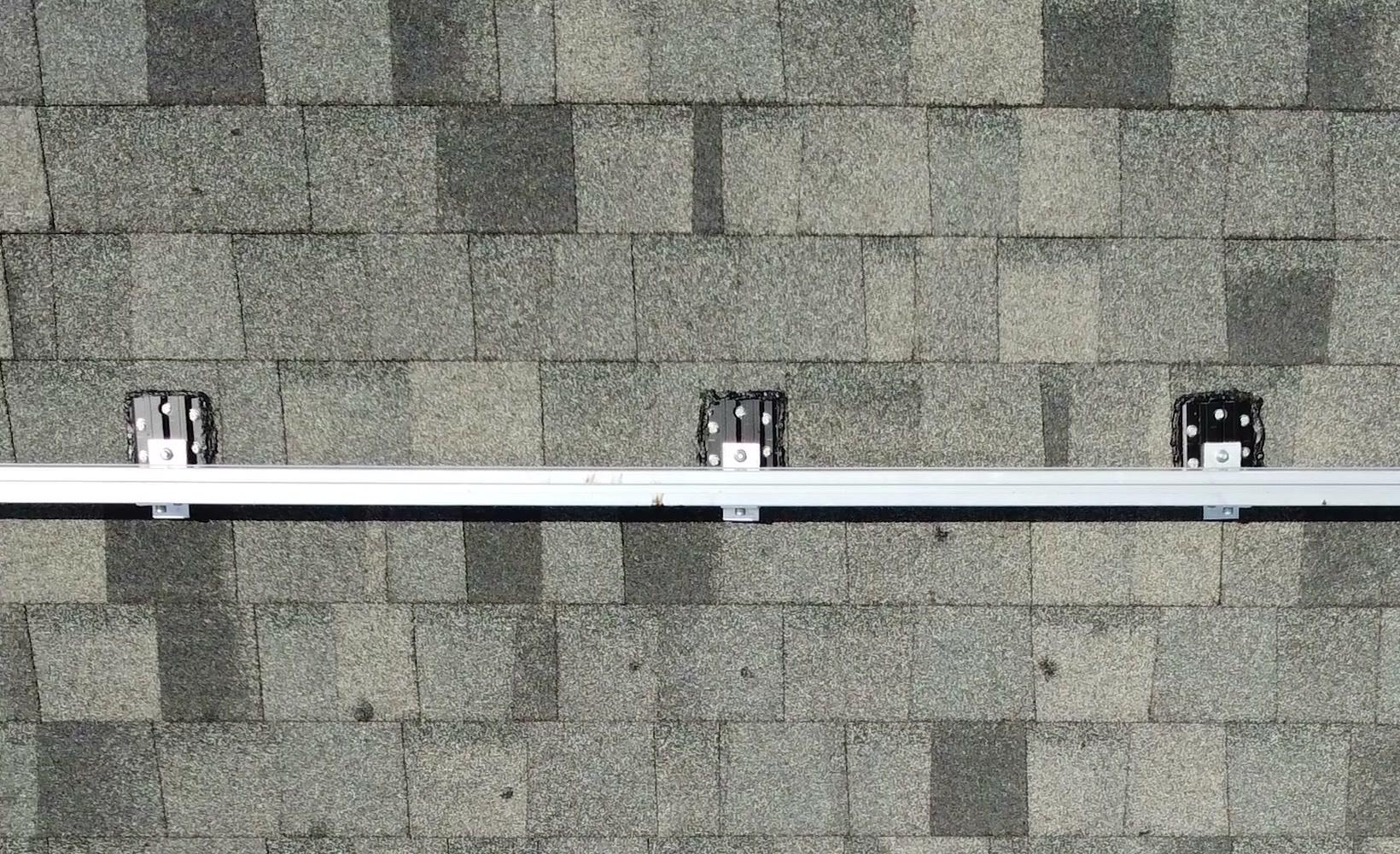
Asphalt shingles and standing seam metal are the easiest roofing to attach panels through, according to NRCan's guidelines. On a shingle roof the racking is fastened through to the framing: our Kanata stage-one video shows the racking and optimizers fastened to the roof before the panels go on.
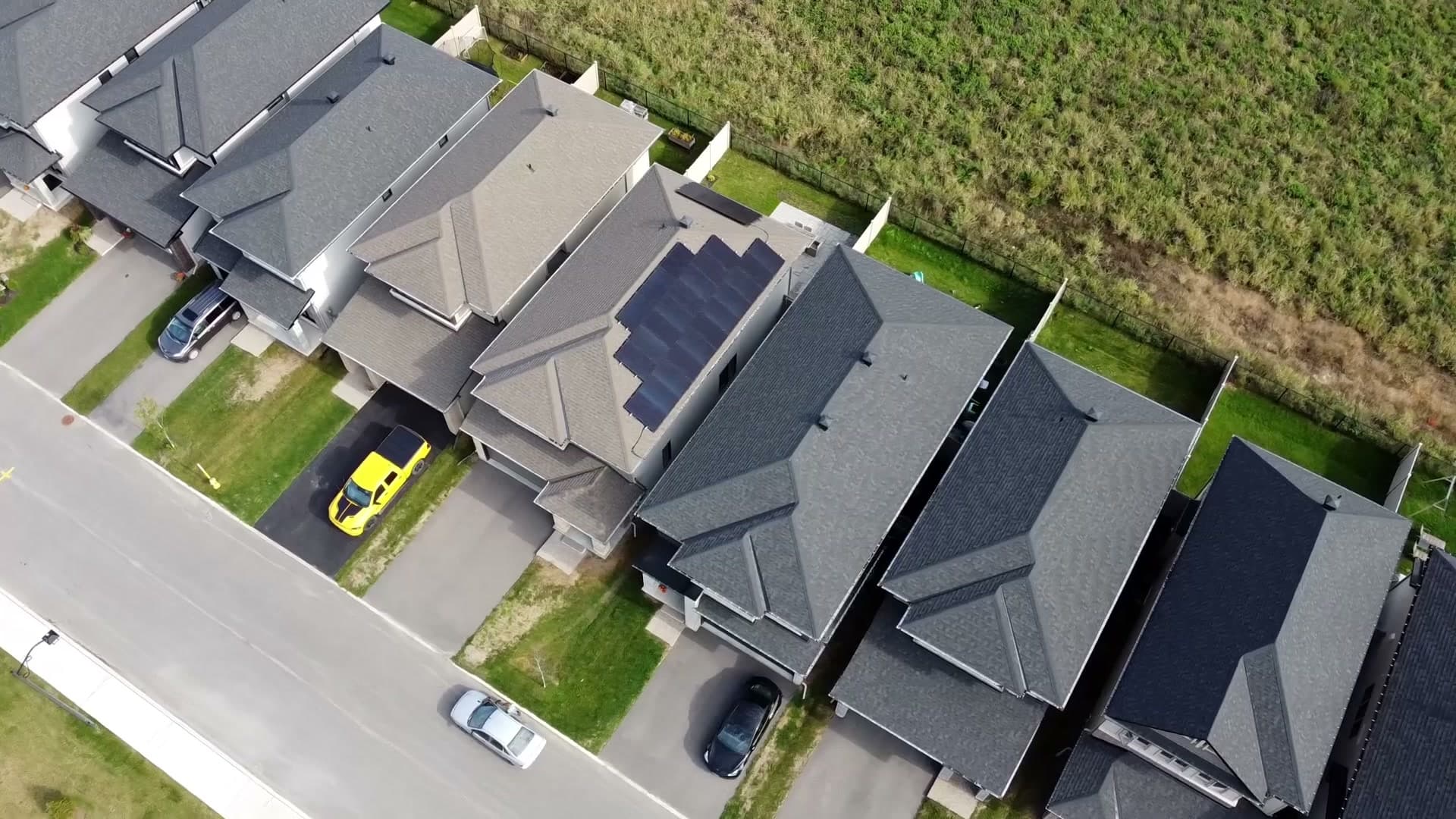
Other roofs work too. In Greely we put 28 panels, 10.5 kW, on an interlocking metal shingle roof. In Ottawa, a 9.9 kW system of 25 panels sits on a roof with many peaks, designed around the faces it has. Both are under grid-tied homes on net metering, and the answer to can solar go on a roof with many peaks or a metal roof is on our projects page.
- Gable roofs: NRCan notes a gable face takes the same number of panels in every row, for a rectangular array with straight edges.
- Hip roofs and valleys: the rows step to follow the diagonal of the hip or valley.
- Flat and low-slope roofs: the City of Ottawa allows elevated racking with fixed or ballast connections, and NRCan notes the rows are spaced so they do not shade each other at low winter sun. For businesses, our commercial and industrial solar page covers rooftop arrays.
How your roof's pitch and direction affect output
Roofers give pitch as rise over a 12-unit run. In degrees, by our arithmetic:
- 4/12: about 18°, the low end of NRCan's recommended range.
- 6/12: about 27°.
- 8/12: about 34°.
- 10/12: about 40°.
- 12/12: 45°.
NRCan's guidelines put the best yearly angle about 10° below the site's latitude, which is about 35° in Ottawa, close to an 8/12 roof. Its Ottawa figures for a south-facing array are 1,201 kWh per kW a year at about 30° and 1,200 at about 45°, against 977 lying flat. So an 8/12 to 12/12 roof sits between two angles that make almost the same yearly total.
East and west faces work as well, inside NRCan's 70% design target, and a roof with both can carry panels on each. How much power your roof makes in each month, and how snow affects it, is in our guide to solar panels in winter.
How an Ottawa roof carries solar panels and snow
The Ontario Building Code sets Ottawa's design ground snow load at 2.4 kPa, a 1-in-50-year value, plus 0.4 kPa for rain on the snow. Kanata's is 2.5 kPa. A roof is designed from those figures (Supplementary Standard SB-1, 2024 Code).
Panels add much less. NRCan budgets an added dead load of at least 0.17 kPa (3.5 psf) for panels and mounting hardware set flush with the roof, about 7% of Ottawa's ground snow load by our arithmetic. Tilted or ballasted racking can add more, which the engineer accounts for.
The City of Ottawa requires a building permit so the building is shown to carry the panels, wind and snow, with the design and site review done by a professional engineer licensed in Ontario.
A flush-mounted system on a low-rise home can be exempt once an engineer has assessed the roof as sound; the full answer to can an Ottawa roof carry solar panels and the snow on them is in our winter guide.
The City also asks for steps to reduce snow and ice sliding off panels near roof edges. Snow clips and snow fences slow that release and break it up, NRCan notes.
How the free assessment checks your roof
A KAJK representative visits your home and reviews the roof and the electrical panel. For the roof, that covers:
- Age and condition
- Whether the roof is new or 10 years old or under, and whether a one-time removal should go in the quote.
- The faces that suit panels
- Which faces point east through west, their pitch, and the space below the ridge once vents, chimneys and skylights are allowed for.
- Shade through the year
- Site modelling and simulations of your roof and the shade on it across the seasons, so the layout makes the most of every face.
- How many panels
- A year of your electricity use sets the system size, and the roof space sets how much of it the roof can carry.
- The permit route
- Whether an engineer's roof assessment lets a flush-mounted system go ahead without a building permit, or the permit is filed. KAJK's process includes acquiring the permits.
You leave with a clear picture of what a system on your roof would look like, and our solar packages show the system sizes to compare before the visit.
Put solar panels on your roof with KAJK
KAJK Constructors, an Ottawa solar installer since 2016, puts solar panels on shingle and metal roofs, on roofs with many peaks and on commercial rooftops, and builds ground mounts and carports where a roof does not suit. We work mainly from Alfred to Pickering.
Call (613) 869-8254 or book a free assessment, and we will check your roof's age, structure, direction and space.
Our process is simple
If you need solar energy solutions, we'll be there from conception to completion. We have the experience and accreditation to lead the way in all phases of your solar project. Here's what you can expect.
Consultation
From your initial assessment to project management, budgeting, scheduling and acquiring your permits, we handle all major aspects of your project.
Design
We design your solar project to ensure that it meets your needs in the most affordable way possible. We do it all, including system designs to as-built drawings.
Procurement
We acquire the best quality materials for your project at the lowest cost possible, giving you the best value for your dollar.
Construction
Our project manager leads all construction projects to ensure that installation, construction and maintenance projects go smoothly and efficiently.
Warranty, operation & maintenance
Once your system is running, we stay with it: warranty support, operation, maintenance and repairs, including on systems other installers put in.
Questions we get asked
Do I have to put solar panels on my roof?
No. A ground mount in the yard or a solar carport over the driveway carries panels too, and KAJK builds both. The roof is the usual choice for a home because its structure is already in place, and rooftop solar is what Ontario's Home Renovation Savings rebate pays for.
Is it better to put solar panels on the roof or on the ground?
For most homes, the roof: NRCan calls roof mounting the most cost-effective choice in most residential installs. A ground mount suits a property with open, sunny space, because its angle is a design choice, fixed or on a tracker, rather than set by the roof's pitch.
Where should solar panels go on a roof?
On the face that points closest to south, below the ridge, clear of vents, chimneys and skylights and out of shade. For a roof being built, NRCan suggests putting vents, stacks and skylights on north-facing slopes to leave the solar face open.
How many solar panels should I put on my roof?
As many as a year of your electricity use calls for, within the space the roof allows. NRCan rates a kW of south-facing panels in Ottawa at about 1,200 kWh a year, so 7 kW covers about 8,400 kWh by our arithmetic. Our homepage questions cover how many panels an Ottawa home needs.
What is the 20% rule for solar panels?
A sellers' rule of thumb: build the system to make about 20% more than you use. In Ottawa, NRCan's yield figure already counts system losses, and net metering resets credit carried through 12 straight months of bills, so we size from your last 12 months of use. More under the 20% rule.
Sources for this page (5), last read 2026-11-09
- Photovoltaic Ready Guidelines, Version 1.0 (2018)Natural Resources Canada, CanmetENERGY, read 2026-11-09
- 2024 Building Code Compendium, Supplementary Standard SB-1: Climatic and Seismic Data, Table 2Government of Ontario, read 2026-11-09
- Solar collector systems (Do I need a building permit?)City of Ottawa, read 2026-11-09
- Photovoltaic potential and solar resource maps of Canada: municipality database (kWh/kWp), OttawaNatural Resources Canada, read 2026-11-09
- Go solar and save up to $5,000 backHome Renovation Savings (IESO and Enbridge Gas), read 2026-11-09
Contact Ottawa's solar energy experts
Ready to get started? Give us a call or send us a quick message for all your solar and green energy needs. The free assessment looks at your roof or site, your last year of electricity use and what you want the system to do, then comes back with a concept design, costs and the equipment we would use.
Monday to Friday, 9 a.m. to 5 p.m.
Saturday and Sunday: closed, visits by appointment