

Ground-mount solar panels in Ottawa and across Ontario
A ground mount puts solar panels on racking anchored in your yard or field instead of on the roof, facing the direction and tilt that produce the most. KAJK designs, builds, repairs and maintains ground-mounted arrays on fixed tilt, seasonal tilt and tracking racking, for residential, commercial and industrial sites across Ontario.
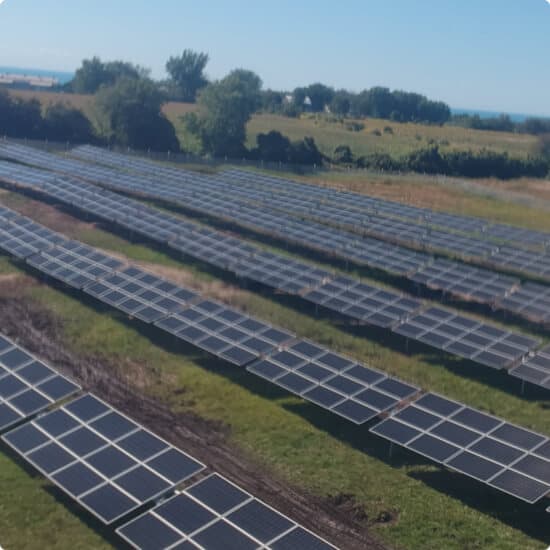
Full-scale ground mount solar solutions in Ontario
KAJK Constructors provides a suite of services to design, build, repair and maintain a variety of ground mount solar panels. These ground mounted solar panels are an alternative to roof mounted solar panels: they are often much more efficient than rooftop solar panels and can be the right choice for both residential and commercial applications.
Better than rooftop solar panel arrays?
Ground mounted solar arrays are known to outperform their rooftop counterparts. Here's why you should choose a ground mounted solar array if one is available for your location:
- They have various racking options and can be tilted for better efficiency as the seasons change.
- Ground mounted arrays can shift to face the sun at all times of day with trackers.
When is a ground mount worth it over the roof?
It is worth it when the roof is the limit. A ground mount earns its extra cost where the roof faces the wrong way, sits under trees, is too small or too flat, or needs replacing before the panels would wear out. In open ground the array can face due south at the best angle, grid-tied or paired with battery storage.
Natural Resources Canada's figures for Ottawa show what that is worth. A south-facing array tilted between about 30° and 45° yields 1,200 kWh a year per kW of panels. The same panels lying flat yield 977, so the right tilt is worth about 23% (our arithmetic on NRCan's table).
If your roof already faces south at a decent pitch and has 25 years of life left, the gain is small and the roof usually wins on cost. NRCan's Photovoltaic Ready Guidelines call roof-mounted equipment the most cost-effective way to install solar in most homes.
Fixed tilt, seasonal tilt or tracker: what each gains in Ottawa
We design and build all three. NRCan's monthly Ottawa data shows the trade-off in kWh per kW of panels; NRCan notes its monthly values do not account for snow.
- Fixed tilt
- One angle all year. About 30° to 45° gives 1,200 kWh per kW. At 60° the year drops to 1,140, but January rises from 79 to 84, when the sun is lowest.
- Seasonal tilt
- Racking you re-angle as the seasons change. Taking the best of NRCan's 30°, 45° and 60° columns month by month adds up to about 1,259 kWh per kW, roughly 5% over fixed tilt.
- Tracker
- Racking that turns to face the sun through the day. NRCan's two-axis tracking figure for Ottawa is 1,667 kWh per kW, about 39% more than fixed tilt, with motors and bearings to maintain.
Foundations for Ottawa frost: why depth alone is not enough
Ontario's Building Code leaves frost depth to local experience (Division B, 1.1.3.2) and sets 1.2 m as the minimum foundation depth for buildings in clay or soils not clearly defined (Table 9.12.2.2). A ground mount is light, so frost pushing its posts up usually governs the design more than weight does.
Researchers measured this in Ottawa. In 1969, E. Penner and W. W. Irwin of the National Research Council set steel pipes 8.9 cm across to 1.5 m in Leda clay on NRC land in Ottawa and recorded uplift of about 2,700 kg over two winters. Their conclusion: a footing below the depth of frost penetration does not ensure stability if the soil freezes to the post.
Helical piles and ground screws hold against that uplift with a helix anchored in unfrozen soil. CHANCE, a helical pile maker, says to place the helix below maximum frost penetration plus at least one helix diameter, and cites the Canadian Foundation Engineering Manual's adfreeze value of 100 kPa for steel in fine-grained soil. A 2015 paper on Ontario solar farms by Kibriya and Tahir reports piles lifted by frost where contractors shortened them to save cost.
Zoning and permits for a ground mount in Ottawa
Ottawa's Zoning By-law 2026-50 is generous to ground-mounted solar. Section 202 sets no maximum size for ancillary solar energy generation in the N1 to N6 neighbourhood zones, and the same in village and rural zones, provided the ground-mounted devices sit in the rear yard and the ground under them is soft landscaped. The City's Development Information Officer can confirm setbacks and height for your lot before the design is final.
The building permit question is narrower than for a roof. Ontario's 2024 Building Code designates solar collectors mounted on a building with a face area of 5 m² or more (Division A, 1.3.3.5); a ground array is not on that list. Norfolk County, for one, states that no building permit is needed when the panel is not installed on a building. Ottawa's own solar page covers building-mounted systems only, so a ground mount's permit status is confirmed with the City for the specific design. The electrical side needs an ESA permit either way.
Trenching the cable to the house
A ground mount adds a trench between the array and the house or service, and its length feeds straight into the power-loss calculation.
Locate the lines
Request free public locates from Ontario Dig Authority (formerly Ontario One Call) at least five business days ahead. Private lines, such as power to a shed or detached garage, or a septic system, need a private locate.
Size the cable for the run
Longer runs lose more power. The cable and equipment power-loss calculation sets the conductor size and inverter location for the actual trench length.
Inspect before backfill
ESA requires an electrical installation to be inspected before it is concealed or buried.
Connect
The cable lands at the electrical service, and the utility connects the system once ESA issues its Connection Authorization.
Snow, tilt and bifacial panels at 45° north
Ottawa sits at 45.4° N with about four months of snow cover a year, the figure given for the University of Ottawa's SUNLAB test site in the IEA's 2021 bifacial report. NRCan notes that arrays at 15° or less shed snow poorly. A ground mount can be set at any angle, high enough to clear drifts and within reach of a roof rake.
Snow has an upside too. Researchers at Queen's University found that snow losses depend on tilt and panel technology, that older prediction methods overstate them, and that bright snow around an array can raise yield, most of all for steep arrays (Andrews, Pollard and Pearce, Solar Energy, 2013). The IEA report lists snow albedo at 0.55 to 0.98 against 0.15 to 0.26 for grass. That is why bifacial panels, which also collect light on their back face, are worth pricing for an open-field array.
Ground mount or rooftop: the trade-offs
Ground mount
- Best tilt and direction, whatever the house does
- No roof penetrations, and nothing to remove at re-roofing
- Within reach for snow clearing and service
- Costs more: foundations, more racking and a trench
- Uses yard space; rear yard only in Ottawa's residential zones
Rooftop
- Uses a structure you already own; NRCan's most cost-effective option in most homes
- No trench and no foundations
- Tilt and direction set by the roof
- Tied to the roof's remaining life
- Snow clearing means a ladder, or waiting for it to slide
Residential, commercial and industrial ground mounts across Ontario
Ground mounts are also built at farm and industrial scale. KAJK reports it “worked on over 150MW on various industrial ground mount solar farms” in its 2016 to 2019 timeline. For a business or farm array above 12 kW AC in Hydro Ottawa's territory, connection starts with a Preliminary Consultation Information Request, answered within 15 days, then a Connection Impact Assessment with drawings stamped by an Ontario professional engineer. See commercial and industrial solar for the business side, or residential solar for rooftop homes.
To find out whether your lot suits a ground mount, book a free assessment: (613) 869-8254.
Our process is simple
If you need solar energy solutions, we'll be there from conception to completion. We have the experience and accreditation to lead the way in all phases of your solar project. Here's what you can expect.
Consultation
From your initial assessment to project management, budgeting, scheduling and acquiring your permits, we handle all major aspects of your project.
Procurement
We acquire the best quality materials for your project at the lowest cost possible, giving you the best value for your dollar.
Design
We design your solar project to ensure that it meets your needs in the most affordable way possible. We do it all, including system designs to as-built drawings.
Construction
Our project manager leads all construction projects to ensure that installation, construction and maintenance projects go smoothly and efficiently.
Green incentives for your solar project
Take advantage of the various incentives and grants available for your solar energy retrofit project. Interest free loans, federal grants, and much more.
Programs change: the federal Greener Homes grant and interest-free loan closed in 2025. Ontario's rebates and the City of Ottawa loan are open, checked on 2026-10-01.
Ontario solar rebates open now“I cannot recommend Kajk Constructors enough. They were so helpful in our understanding of the solar system.”
Questions we get asked
Are ground mounted solar panels worth it?
Yes, when the roof is the limit. In Ottawa a south-facing array at 30° to 45° yields 1,200 kWh per kW a year (NRCan), about 23% more than the same panels lying flat. If your roof already faces south at a good pitch and has 25 years left, rooftop usually costs less for close to the same output.
Is it possible to mount solar panels on the ground?
Yes. The panels sit on fixed, seasonal-tilt or tracking racking anchored by helical piles, ground screws or concrete, with a buried cable to the house. In Ottawa's neighbourhood, village and rural zones, Zoning By-law 2026-50 allows ground-mounted solar of any size in the rear yard if the ground beneath it is soft landscaped.
What are the disadvantages of ground mounted solar panels?
More upfront cost for foundations, racking and trenching; yard space; Ottawa's rear-yard rule in residential zones; grass to keep under the array; and exposure to mowers, snowblowers and animals. In Ottawa clay the foundations must also resist frost lifting the posts, which is the main structural load on a light array.
Is it cheaper to ground mount solar panels?
Usually not upfront. NRCan's Photovoltaic Ready Guidelines call roof-mounted equipment the most cost-effective option in most homes, because the structure already exists. A ground mount can still cost less per kWh where the roof would need replacing first, or would produce well below the 1,200 kWh per kW an open south-facing site gets.
Can a ground mount get the Home Renovation Savings rebate?
The program's solar application asks where the panels go: the home's roof, the roof of a permanent existing structure on the property, or other. Ground mounts are not named either way, so eligibility is settled at pre-approval, before equipment is bought. Read 2026-10-01; terms change. Details are on our incentives page.
Sources for this page (16), last read 2026-10-01
- Photovoltaic potential and solar resource maps of Canada (municipal data file municip_potentiel-potential.csv)Natural Resources Canada, read 2026-10-01
- Photovoltaic Ready Guidelines, Version 1.0 (2018)Natural Resources Canada, CanmetENERGY, read 2026-10-01
- 2024 Building Code Compendium, Volume 1Publications Ontario (Ministry of Municipal Affairs and Housing), read 2026-10-01
- Adfreezing of Leda clay to anchored footing columns, E. Penner and W. W. IrwinNational Research Council Canada (Canadian Geotechnical Journal 6(3), 1969), read 2026-10-01
- Using Helical Piles to Resist Frost Heave (Alan J. Lutenegger, 2026-03-31)Hubbell CHANCE Foundation Solutions, read 2026-10-01
- Adfreeze Forces on Lightly Loaded Pile Foundations of Solar PV Farms in Cold Regions, T. Kibriya and L. TahirAmerican Journal of Civil Engineering and Architecture 3(4), 2015, read 2026-10-01
- Zoning By-law 2026-50, Part 2 General Provisions, Section 202City of Ottawa, read 2026-10-01
- Detached garages and sheds (Do I need a building permit?)City of Ottawa, read 2026-10-01
- Solar collector systems (Do I need a building permit?)City of Ottawa, read 2026-10-01
- Solar Panels (building permit guide)Norfolk County, read 2026-10-01
- Public Utility LocatesOntario Dig Authority (formerly Ontario One Call), read 2026-10-01
- Notifications and InspectionsElectrical Safety Authority, read 2026-10-01
- DER connection processHydro Ottawa, read 2026-10-01
- Bifacial Photovoltaic Modules and Systems, Report IEA-PVPS T13-14:2021IEA PVPS Task 13, read 2026-10-01
- The Effects of Snowfall on Solar Photovoltaic Performance, R. W. Andrews, A. Pollard and J. M. PearceSolar Energy 92 (2013), via Michigan Tech Digital Commons, read 2026-10-01
- Solar and Battery Storage Pre-Installation Application Checklist (version October 2025)Home Renovation Savings (IESO and Enbridge Gas), read 2026-10-01
Contact Ottawa's solar energy experts
Ready to get started? Give us a call or send us a quick message for all your solar and green energy needs. The free assessment looks at your roof or site, your last year of electricity use and what you want the system to do, then comes back with a concept design, costs and the equipment we would use.
Monday to Friday, 9 a.m. to 5 p.m.
Saturday and Sunday: by appointment