

Solar battery storage and home battery backup in Ottawa
KAJK Constructors designs and installs lithium battery storage for solar systems in Ottawa, from a single home to commercial and industrial sites. A battery keeps your power on in an outage, which grid-tied panels cannot do on their own, and covers the on-peak hours when Ontario electricity costs the most. The incentive you choose decides how the system is wired, so that choice comes before anything is ordered.
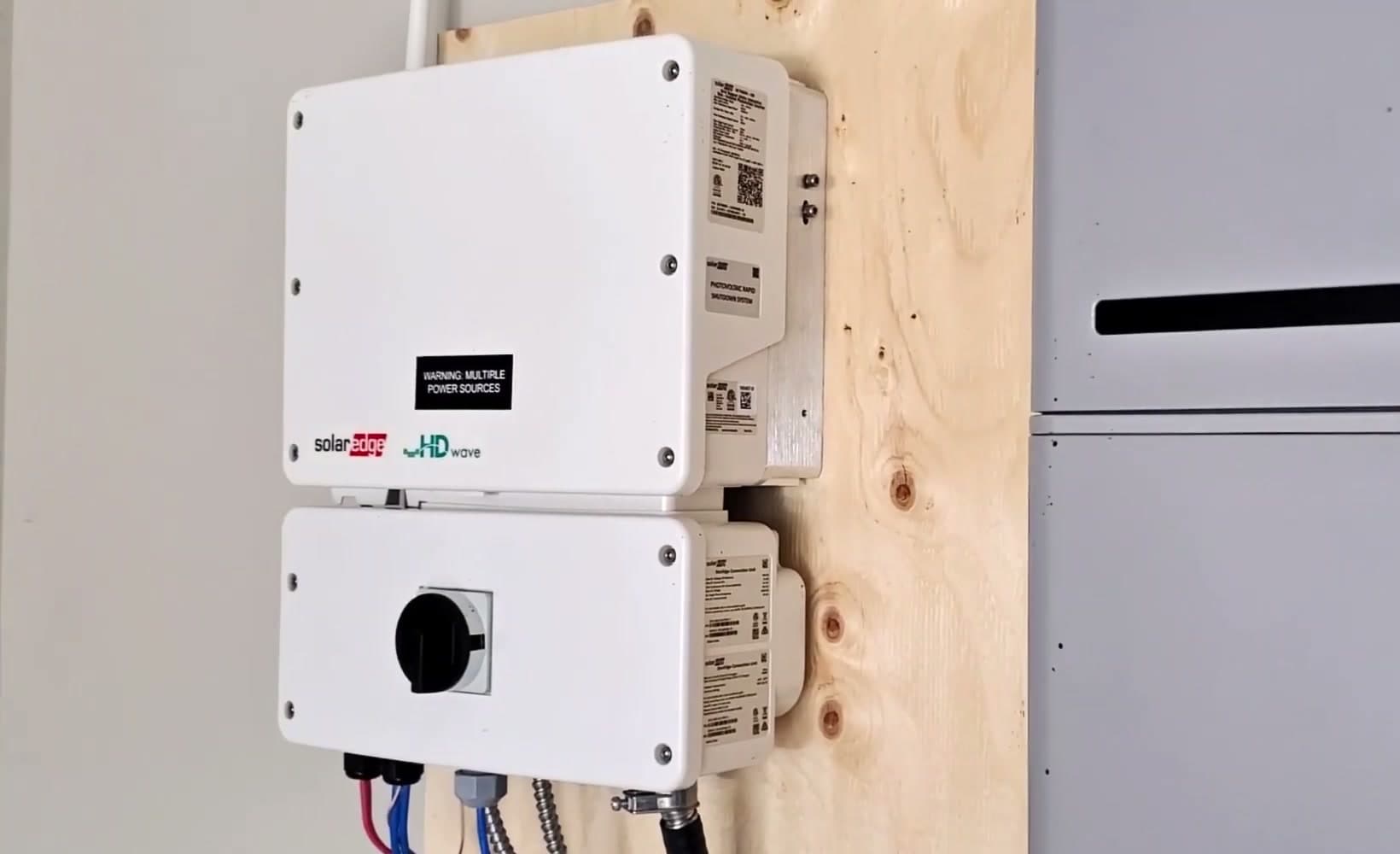
Lithium ion batteries for solar energy storage
Lithium ion batteries have proven to be an extremely useful part of solar energy projects: they let you store extra solar energy, which can then be used on gloomy days and whenever backup power is needed. At KAJK Constructors, we help you benefit from this solar energy storage. From the product selection to installation and more, we'll be by your side.
Solar energy, stored for rainy days
One of the main concerns we hear about solar energy is the lack of sufficient sunlight, on a rainy day for example. With a lithium battery installed, all of those concerns wash away. Why lithium batteries are a great fit for solar projects:
- Keeps you comfortable and powered during outages.
- Save on energy costs when electricity is on-peak.
Why solar panels alone go dark in a power outage
A grid-tied solar system has to stay synchronized with the grid to run. When Hydro Ottawa's supply drops, the panels stop feeding your home. CanREA's 2024 Go Solar Guide says the panels “will not power the home during a power outage unless there is energy storage attached.” The shutdown is deliberate: ESA warns that power fed back into a dead line can put utility crews “in serious jeopardy.”
A battery built for backup changes that. When the grid fails, the system disconnects from the street and runs the circuits it was designed to carry from stored energy, recharged by the panels whenever the sun is up. On normal days it carries surplus solar into the evening and through a run of grey weather.
How long it lasts depends on capacity and on what you ask it to run. Hydro Ottawa's battery storage page says the right size depends on your energy use and how much backup you need. For scale, the Home Renovation Savings program's contractor checklist (October 2025) describes a typical home project as 5 to 10 kW of solar with a 13.5 kWh battery.
Is battery storage worth it with solar in Ontario?
It pays off when at least one of three things is true: you need power during outages, you are on a rate plan with an expensive peak, or the rebate path suits your house. The second is easy to check. These are the Ontario Energy Board's prices, set for November 1, 2025 and still the current table when we read it on 2026-10-01. The OEB resets them every November 1.
On Ultra-Low Overnight, the weekday 4 p.m. to 9 p.m. price is ten times the overnight price. Every kilowatt-hour your battery supplies in that window is one you do not buy at 39.1 cents. On Time-of-Use the gap is about two to one, so there the savings case is thinner and backup does more of the work.
Time-of-Use (TOU)
- Off-peak 9.8¢/kWh: weekdays 7 p.m. to 7 a.m., weekends and holidays all day
- Mid-peak 15.7¢/kWh
- On-peak 20.3¢/kWh: winter weekdays 7 to 11 a.m. and 5 to 7 p.m., summer weekdays 11 a.m. to 5 p.m.
Ultra-Low Overnight (ULO)
- Ultra-low 3.9¢/kWh: every day, 11 p.m. to 7 a.m.
- Weekend off-peak 9.8¢/kWh and weekday mid-peak 15.7¢/kWh
- On-peak 39.1¢/kWh: weekdays 4 p.m. to 9 p.m., all year
The $5,000 battery rebate, and what it costs you
Ontario's Home Renovation Savings program, run by Enbridge Gas and Save on Energy, pays $300 per kWh of battery, up to half the battery's cost and no more than $5,000. Panels earn a separate rebate of $1,000 per kW, also capped at $5,000. We read those terms on homerenovationsavings.ca on 2026-10-01. The catch is in the program's own words: anyone who takes the incentive is “not eligible to participate in a net-metering agreement” with their utility.
Home Renovation Savings rebate
- Battery: $300/kWh, up to 50% of its cost, capped at $5,000
- Only with a new solar system; standalone batteries and add-ons to existing panels do not qualify
- Load displacement only: no net metering for that system, at any time
- Written pre-approval from the program and Hydro Ottawa before anything is bought or installed
Net metering with Hydro Ottawa
- Surplus solar goes to the grid for a bill credit at the same rates you pay (O. Reg. 541/05)
- Credits carry forward for up to 12 months, then expire
- A battery can join a solar system on net metering; a battery on its own does not qualify
- No Home Renovation Savings rebate on that system
The negatives of a home battery, stated plainly
Most of what turns up under “battery storage negatives” concerns the grid-scale projects proposed around Ottawa. For a battery at a home or a business, these are the trade-offs:
- The rebate covers part, not all
- At $300 per kWh, the program's typical 13.5 kWh battery earns $4,050, and only if that is no more than half the battery's cost. You pay the rest.
- Capacity is fixed
- A battery holds a set number of kilowatt-hours. In a long winter outage with little sun it runs only what it was sized for, so sizing starts from the circuits you cannot be without.
- It has to live in the right room
- ESA's summary of the 2024 code's residential battery rules (Plugged In, Summer 2024) allows a battery in a garage, on an outside wall, or in a dedicated room with a smoke alarm and a self-closing door. Never in a sleeping area or a room that opens directly into one.
- More approvals than panels alone
- Ontario requires the system to be certified to ANSI/CAN/UL 9540 or field-evaluated (ESA Bulletin 64-7-2). The work needs an ESA notification, and Hydro Ottawa connects nothing until ESA issues a Connection Authorization.
- Existing solar gets no rebate
- The Home Renovation Savings rebate is for new systems only. Add a battery to panels you already own and that program pays nothing toward it.
From the assessment to a working battery
We stay with the project from product selection to installation. On a home system with a battery, the order of work looks like this:
Pick the path
At the free assessment we look at your loads, your panel, your rate plan and which incentive fits, because the rebate and net metering cannot be swapped once the system is in.
Apply before buying
For the rebate, the pre-installation application goes in with a quote dated within 60 days. For net metering on a system of 12 kW AC or less, Hydro Ottawa's service request takes 15 days, and up to 60 on complex jobs.
Install under an ESA notification
The battery, the inverter and the backup panel go in, the electrical work is filed with ESA, and ESA inspects it.
Connect and claim
Hydro Ottawa connects after ESA's Connection Authorization. On the rebate path, the post-installation application is due within 30 days of installation.
Battery storage for commercial and industrial sites
We size lithium storage for large commercial and industrial buildings as well as homes. Above 12 kW AC, Hydro Ottawa requires a Connection Impact Assessment stamped by an Ontario professional engineer, and its faster simplified assessment excludes any project with batteries. The standard fee for a generator up to 500 kW was $1,130 when we read it on 2026-10-01. Our commercial and industrial solar page covers the incentives a business can use.
Storage also pairs with charging. ESA Bulletin 86-1-7 notes that many smart chargers let you choose whether the car charges from the grid, the panels or the battery, which matters if you plan an EV charger after the panels. For a house, start with residential solar, and see the full list of current energy incentives before you decide.
Our process is simple
If you need solar energy solutions, we'll be there from conception to completion. We have the experience and accreditation to lead the way in all phases of your solar project. Here's what you can expect.
Consultation
From your initial assessment to project management, budgeting, scheduling and acquiring your permits, we handle all major aspects of your project.
Procurement
We acquire the best quality materials for your project at the lowest cost possible, giving you the best value for your dollar.
Design
We design your solar project to ensure that it meets your needs in the most affordable way possible. We do it all, including system designs to as-built drawings.
Construction
Our project manager leads all construction projects to ensure that installation, construction and maintenance projects go smoothly and efficiently.
Green incentives for your solar project
Take advantage of the various incentives and grants available for your solar energy retrofit project. Interest free loans, federal grants, and much more.
Programs change: the federal Greener Homes grant and interest-free loan closed in 2025. Ontario's rebates and the City of Ottawa loan are open, checked on 2026-10-01.
Ontario solar rebates open now“Khaled and his crew did an outstanding job with our solar install. Every step of the process was thoroughly explained and the installation was seamless”
Questions we get asked
Where can I buy solar storage batteries in Canada?
Through the installer who designs your system, not off a shelf. Ontario requires an energy storage system to be certified to ANSI/CAN/UL 9540, or field-evaluated, before it is used or sold here (ESA Bulletin 64-7-2). The Home Renovation Savings program also tells homeowners not to buy equipment before written pre-approval. Your installer sizes the battery to the panels, files the ESA notification and arranges Hydro Ottawa's connection.
Does a battery qualify for the Home Renovation Savings Program?
Yes, if it is installed with a new solar system, sized to it and charged mainly by the panels rather than the grid. The rebate is $300 per kWh, up to 50% of the battery's cost, capped at $5,000 (read 2026-10-01). Taking it rules out net metering for that system permanently. Program terms change, so the assessment confirms what applies before you sign.
Can I add a battery to solar panels I already have?
Yes. Hydro Ottawa allows a battery paired with a solar system to form a net-metering installation, though a battery on its own does not qualify. The Home Renovation Savings rebate will not help here: it covers new systems only, and expansions are excluded. The addition still needs an ESA notification, an inspection and Hydro Ottawa's connection approval.
Do I need a permit to install a home battery in Ottawa?
You need ESA's, which is the electrical permit. ESA says a notification of work is required with each energy storage installation, and it inspects the system afterwards. Hydro Ottawa will not connect a system that exports to its grid until ESA issues a Connection Authorization. Your installer files both; ask for copies for your records.
How big a battery does a home need?
Big enough for the circuits you want running in an outage and the evening hours you want covered. The Home Renovation Savings checklist calls 5 to 10 kW of solar with a 13.5 kWh battery typical, and it asks contractors to list major loads such as EV charging, a heat pump or a hot tub. Sizing starts from your actual loads.
Sources for this page (12), last read 2026-10-01
- Electricity rates (current prices set for November 1, 2025)Ontario Energy Board, read 2026-10-01
- The benefits of solar (solar and battery storage rebates)Home Renovation Savings (Enbridge Gas and Save on Energy, IESO), read 2026-10-01
- Solar and Battery Storage Stream: Pre-Installation Application Checklist for Contractors (version October 2025)Home Renovation Savings (IESO), read 2026-10-01
- Battery storageHydro Ottawa, read 2026-10-01
- Types of DERs (net metering)Hydro Ottawa, read 2026-10-01
- DER connection processHydro Ottawa, read 2026-10-01
- O. Reg. 541/05: Net Metering (current to 2026-09-28)Government of Ontario (e-Laws), read 2026-10-01
- Go Solar Guide 2024Canadian Renewable Energy Association (CanREA), read 2026-10-01
- Podcast Episode 5: Energy Storage Systems (May 2022)Electrical Safety Authority (ESA), read 2026-10-01
- Bulletin 64-7-2: Installation and Approval of Energy Storage Systems (October 2023)Electrical Safety Authority (ESA), read 2026-10-01
- Plugged In, Summer 2024 (2024 CE Code residential ESS rules)Electrical Safety Authority (ESA), read 2026-10-01
- Bulletin 86-1-7: Electric vehicle charging systems (May 2025)Electrical Safety Authority (ESA), read 2026-10-01
Contact Ottawa's solar energy experts
Ready to get started? Give us a call or send us a quick message for all your solar and green energy needs. The free assessment looks at your roof or site, your last year of electricity use and what you want the system to do, then comes back with a concept design, costs and the equipment we would use.
Monday to Friday, 9 a.m. to 5 p.m.
Saturday and Sunday: by appointment