

Solar inverter: string, microinverters or hybrid for your home
A solar inverter turns the direct current your panels make into the alternating current your home uses. A home has four choices: a string inverter, a string with optimizers, a microinverter on each panel, or a hybrid that also runs a battery.
Shade, roof faces and battery plans decide it, and we match one at a free assessment for solar panels in Ottawa.
On this page
- What a solar inverter does in a home system
- The four inverter set-ups for a home
- Why your roof decides which inverter fits
- How a hybrid inverter keeps the battery option open
- How the inverter is sized and connected in Ontario
- How KAJK picks the inverter for your property
- Plan your inverter with KAJK
- Questions
What a solar inverter does in a home system
Panels make direct current (DC). Your outlets, your appliances and the grid run on alternating current (AC). The US Department of Energy describes the inverter as the device that converts one to the other, switching the DC input back and forth very rapidly and shaping it into a clean sine wave the grid can take.
It does more than convert. On most home systems the same unit monitors output and reports it to an app, and on a battery system it is what runs the house during an outage, when it is designed to.
On a grid-tied home, the inverter feeds your electrical panel first, and what the house does not use flows out through the meter. How that surplus is credited is in our guide to net metering in Ontario.
The four inverter set-ups for a home
The panels can be the same in all four. What changes is where the power is converted and how each panel is managed:
- String inverter
- One inverter on the wall converts the power of a whole row of panels, called a string. It suits a roof face in full sun.
- String inverter with optimizers
- A small optimizer under each panel tunes that panel's output before it reaches the string inverter. SolarEdge says its optimizers get more energy from each panel by reducing shading and mismatch losses, and add monitoring panel by panel.
- Microinverters
- A small inverter under each panel converts its power on the roof. The Department of Energy notes that shade or damage on one panel then leaves the power from the others untouched.
- Hybrid inverter
- One unit that converts the panels' power and also charges and runs a battery, so the system can keep the house going when the grid is down.
Why your roof decides which inverter fits
Shade and roof faces matter most. A string inverter treats its row of panels as one, so the Department of Energy notes the whole string makes less when one panel is shaded. On a roof with a chimney, a tall tree or several small faces, we fit optimizers or microinverters, which keep each panel working on its own.
A single face in full sun is where a plain string inverter fits, with one unit to service and nothing under the panels.
Our own installs show the whole range. On the showcase videos on our solar projects page, a 14.4 kW home on 30 panels runs a string inverter (Showcase #6). A 13.5 kW home on 24 panels has optimizers on a string inverter (Showcase #25).
A 12.7 kW home on 27 panels has one microinverter per panel (Showcase #7), and a 9.3 kW home on 23 panels uses dual-input microinverters (Showcase #24).
How a hybrid inverter keeps the battery option open
If a battery may come later, choose the inverter with that in mind. A hybrid inverter converts the panels' power and also charges and runs a battery, so adding storage does not mean replacing the unit on the wall. The Department of Energy notes that solar-plus-battery systems rely on these advanced inverters to run without the grid in an outage.
That is the job a battery does. The Canadian Renewable Energy Association (CanREA) notes that panels on their own will not power a building during an outage unless storage is attached, so a home that wants backup plans for it from the start.
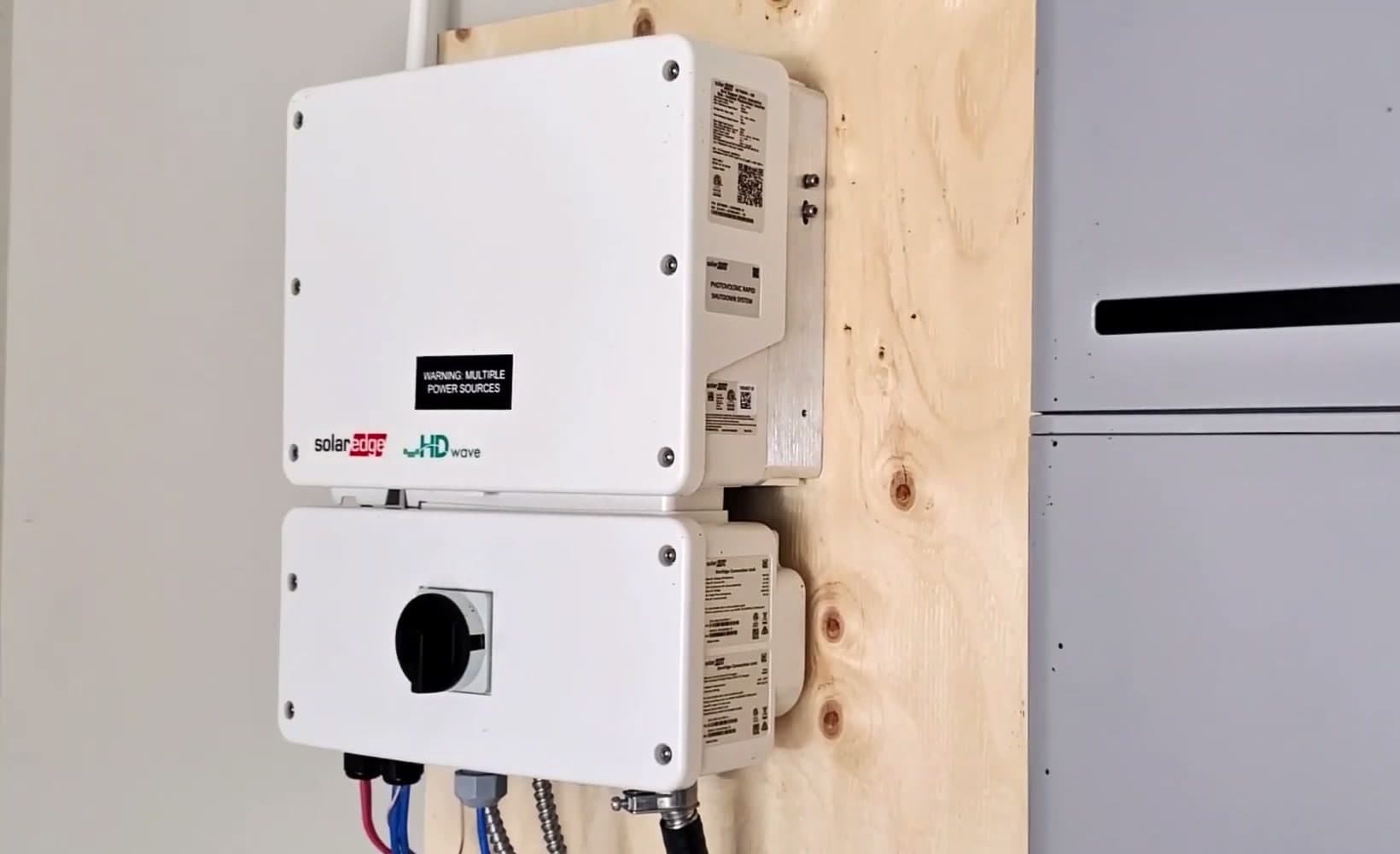
Many of our battery homes on video run hybrid inverters: an 11.4 kW home on 28 panels (Showcase #19) and a 9.1 kW home on 20 panels with a backup interface (Showcase #12). Sunlight backup is the lighter version: an 8.4 kW home on 22 panels (Sunlight-Backup Showcase #14) runs a hybrid inverter that keeps essential loads on in an outage while the sun shines, with no battery bank.
The Home Renovation Savings Program pays $300 per kWh of storage, up to $5,000, for a battery paired with a new solar system, and $1,000 per kW DC of panels, up to $5,000 (program requirements, read 2026-11-23). The terms are on our Home Renovation Savings rebate page, and the battery itself is on our battery storage page.
How the inverter is sized and connected in Ontario
Four things set the inverter's size and how it joins your home's wiring:
- Sized after the design
- We conduct a full cable and equipment power loss calculation, so the wire runs and the inverter are sized before the panel count is fixed.
- Within your panel's limit
- Under Rule 64-112 of the Ontario Electrical Safety Code, as ESA's Bulletin 64-1-4 (May 2024) explains, the breakers feeding a home's panel, the inverter's included, may add up to 125% of its busbar rating. Above that, the inverter connects on the supply side of the main disconnect.
- A disconnect for each inverter
- The same bulletin calls for separate disconnecting means and overcurrent protection for each inverter, while a set of microinverters counts as one source, with the maker's instructions setting how many share a circuit. Our video "The Steps to Solar: Inverters and Disconnects" shows both on real installs.
- Certified and filed with ESA
- ESA requires electrical products to be approved by an accredited agency before they are used in Ontario, and an inverter certified to CSA C22.2 No. 107.1 carries its maximum output current on the nameplate. Wiring it in is electrical work, which the Ontario Electrical Safety Code requires to be reported to ESA. We file the notification.
How KAJK picks the inverter for your property
The inverter is chosen inside the design, in the order we run every job:
Consultation
A visit to your roof, its shade and your electrical panel, and a year of your bills.
Design
Site modelling of each roof face, then the power-loss calculation that sizes the inverter and the wire runs.
Procurement
Brands we install include Enphase and SolarEdge, among others. The inverters in our install videos are SolarEdge HD-Wave, which SolarEdge backs with a standard 12-year warranty, extendable to 20 or 25 years depending on the model.
Construction
Our own crews do all the work: racking, then the inverter or the units under each panel, the disconnects and the connection to your panel, with the ESA notification filed.
Warranty, operation and maintenance
If an inverter needs attention later, our solar panel repair and maintenance service works on string inverters, microinverters and optimizers, on our systems and on other installers'.
Plan your inverter with KAJK
KAJK Constructors has designed and installed solar since 2016 for homes, businesses and farms, mainly between Alfred and Pickering. Whether your roof suits a string, optimizers, microinverters or a hybrid, the free assessment answers it for your house.
Call (613) 869-8254 or book a free assessment. If you are still weighing the whole system, our guide to off-grid, grid-tied or hybrid systems compares the three.
Our process is simple
If you need solar energy solutions, we'll be there from conception to completion. We have the experience and accreditation to lead the way in all phases of your solar project. Here's what you can expect.
Consultation
From your initial assessment to project management, budgeting, scheduling and acquiring your permits, we handle all major aspects of your project.
Design
We design your solar project to ensure that it meets your needs in the most affordable way possible. We do it all, including system designs to as-built drawings.
Procurement
We acquire the best quality materials for your project at the lowest cost possible, giving you the best value for your dollar.
Construction
Our project manager leads all construction projects to ensure that installation, construction and maintenance projects go smoothly and efficiently.
Warranty, operation & maintenance
Once your system is running, we stay with it: warranty support, operation, maintenance and repairs, including on systems other installers put in.
Questions we get asked
What is a photovoltaic inverter?
It is the device that turns the direct current from solar panels into the alternating current a home and the grid use. On most home systems it also monitors output and, paired with a battery, keeps power on in an outage, by the US Department of Energy's description.
Can a solar system work without an inverter?
A system that powers a home needs one, because panels make DC and a house runs on AC. CanREA lists one or more inverters as a standard part of a grid-tied system, either one on the wall or one under each panel.
How many types of solar inverters are there?
For a home there are four set-ups: a string inverter, a string inverter with optimizers, microinverters, and a hybrid inverter that also runs a battery. Utility-scale solar plants use central inverters, by the Department of Energy's list.
What size inverter does a home system need?
One matched to the array, which is sized from a year of your bills. We run a cable and equipment power loss calculation so the inverter and wire runs are sized before the panel count is fixed, and the connection stays within Ontario's 125% busbar limit.
How long is a solar inverter warranty?
It is set by the maker. SolarEdge, whose inverters appear in our install videos, gives a standard 12-year inverter warranty, extendable to 20 or 25 years depending on the model. The concept design for your home names the inverter we propose.
Which inverter brand is good for a home?
The one that fits your roof and battery plans and carries a mark ESA recognizes. We install Enphase, SolarEdge and other makers' equipment, and choose the brand after the design, not before.
Can I replace a solar inverter myself?
Replacing an inverter is electrical work, and the Ontario Electrical Safety Code requires almost all electrical work to be reported to ESA with a notification filed before it starts. Our repair and maintenance service works on inverters on our systems and other installers'.
Sources for this page (9), last read 2026-11-26
- Solar Integration: Inverters and Grid Services BasicsUS Department of Energy, Solar Energy Technologies Office, read 2026-11-26
- Bulletin 64-1-4: Utility-interactive inverters (issued May 2024)Electrical Safety Authority (ESA), read 2026-11-26
- Notifications and InspectionsElectrical Safety Authority (ESA), read 2026-11-26
- Recognized Approval MarksElectrical Safety Authority (ESA), read 2026-11-12
- How Solar WorksCanadian Renewable Energy Association (CanREA), read 2026-11-26
- SolarEdge Power OptimizersSolarEdge, read 2026-11-26
- I Have a Warranty QuestionSolarEdge, read 2026-11-26
- Solar and Storage Program Stream RequirementsHome Renovation Savings Program (Enbridge Gas and Save on Energy), read 2026-11-23
- Showcase video descriptions and The Steps to Solar: Inverters and Disconnects (uploaded 2025-01-28)KAJK Constructors (YouTube), read 2026-11-26
Contact KAJK's solar energy experts
Ready to get started? Give us a call or send us a quick message for all your solar and green energy needs. The free assessment looks at your roof or site, your last year of electricity use and what you want the system to do, then comes back with a concept design, costs and the equipment we would use.
Monday to Friday, 9 a.m. to 5 p.m.
Saturday and Sunday: closed, visits by appointment